Honest Christianity – chaplaincy and the local church

Sally and Paul Nash's avatarMarker Posts and Shelters

Renewal

This week I was invited to speak at what was a reasonably unique event in my experience. Itwas not the theme that was unusual – I often get asked to speak about bereavement. It was not even the group – volunteer chaplains. It was that the training session on bereavement for volunteer chaplains was being run by a local church as a part of a wider training programme.

It is the vision of Renewal Church in Solihull to develop their members to reach out in their
local community. Chaplaincy is perceived as an effective way to serve the local community and is part of the mission strategy of the church. Church members care, listen, serve people where they are to be found in places they have gone to willingly or unwillingly – GP surgeries, playing sports, hospitals and hospices, schools… The training is helping them to be intentional and purposeful…

View original post 33 more words

Psychological Labeling

A fascinating study done by David Rosenhan of Stanford University illustrates the impact of psychiatric labeling. Rosenhan and several colleagues had themselves committed to mental hospitals  with a diagnosis of “schizophrenia.” After being admitted, each of these pseudo-patients dropped all pretense of mental illness. Yet, even though they acted completely normal, none of the researchers was ever recognized by hospital staff as a phony patient. Real patients were not so easily fooled. It was not unusual for a patient to say to one of the researchers, “You’re not crazy, you’re checking up on the hospital!” or “You’re a journalist.”

To record his observations, Rosenham took notes by carefully jotting things on a small piece of paper hidden in his hand. However, he soon learned that stealth was totally unnecessary. Rosenhan simply walked around with a clipboard, recording observations and collecting data. No one questioned this behavior. Rosenhan’s note taking was just regarded as a symptom of his “illness.” This observation clarifies why staff members failed to detect the fake patients. Because they were in a mental ward, and because they had been labeled schizophrenic, anything the pseudo-patients did was seen as a symptom of psychopathology.

As Rosenham’s study shows, it is far better to label problems than to label people. Think of the difference in impact between saying “You are experiencing a serious psychological disorder” and saying, “You are a schizophrenic.”

-Dennis Coon, “Introduction to Psychology: Gateways to Mind and Behavior,” 9th edition. pages 556-557

Completion of Clinical Pastoral Orientation

11046403_10153105053377622_5584151572231003126_n

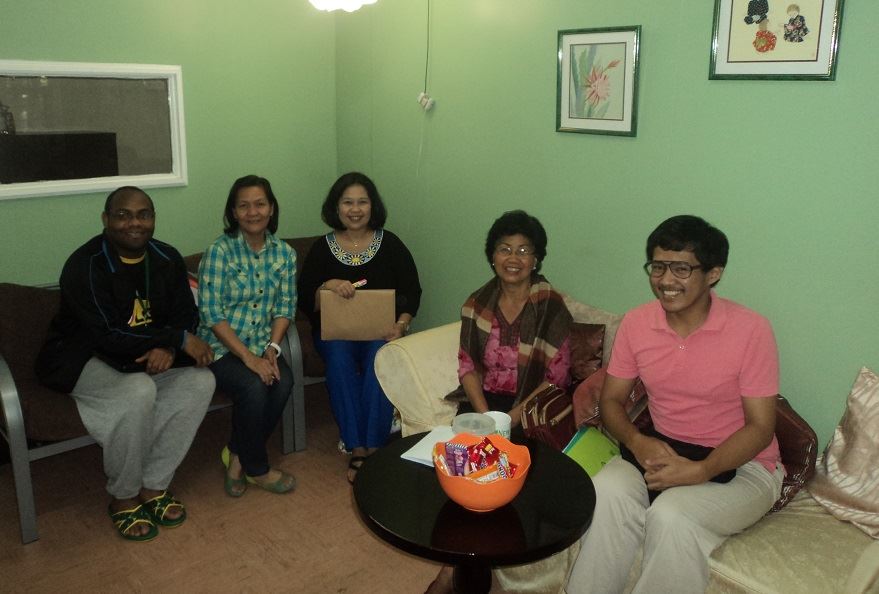
Congratulations to Keishon, Lalaine, Tess, and German in completing Clinical Pastoral Orientation. They are seated here on their final meeting with Celia (their instructor in the middle). CPO is a mini-CPE (about 1/4 of a full unit). It provides the structure and educational philosophy of CPE while set up to be more compatible with a Bible School or Seminary quarterly or tri-mestral program. For some, the program is enough to provide insight into pastoral care and into self, while for others, it provides a stepping stone to the regular Clinical Pastoral Education program.

Three of them will be starting Clinical Pastoral Education (CPE) on March 16.

Update on CPE Program

Clinical Pastoral Education (CPE) is a program of pastoral care training that was developed in the 1920s and has become popular worldwide. It develops individuals to integrate their role as pastoral care persons (whether as clergy or laity) that combines standard small group lecture with group process, individual supervision, and practical (“hands-on”) ministry. The venue for practical ministry is typically in hospitals (serving as a chaplain intern), but may also be done in jails, hospices, churches, and other settings.

The CPE done at Bukal Life Care is certified by the College of Pastoral Supervision & Psychotherapy (www.pastoralreport.com) and CPSP-Philippines (www.cpspp.org)

CPE is done in units.

  • Each unit consists of 400 hours, and takes (typically) about 11 weeks. The 400 hours consists of 300 hours of practical ministry and reflections, and 100 hours of formal training, group work and individual supervision.

  • A half unit consists of approximately 200 hours and takes (typically) about 6 weeks. The 200 hours is divided in a similar manner between practical ministry and other training modes.

Many religious and health institutions require, or at least recommend, that their workers have completed either half of a unit, or one full unit.

Cost Breakdown

  • Full Unit.

    • Supervisory Fee**             10,000 Php

    • Administrative Fee**            2,000 Php

    • Ministerial Support**           2,000 Php

                                          Total: 14,000 Php

  • Half Unit.

    • Supervisory Fee**              5,000 Php

    • Administrative Fee**          1,500 Php

    • Ministerial Support**          1,000 Php

                                                      Total: 7,500 Php

**Supervisory Fee covers the tuition and supervision cost for the trainees individual trainer/supervisor. Administrative fee covers cost of records, certificates, ID, snacks during training, and testing. Ministerial Support covers costs for onsite ministerial coverage, and outside trainers as needed.

NOTE 1: The amount charged does not cover transportation, food, or lodging of individuals

NOTE 2: Scholarship arrangements are sometimes available on a case by case basis. Need is the primary, but not only, criteria.

http://www.bukallifecare.org

CPE Summer Intensive (Mar-May) 2015

Trying to figure out how many have committed to do CPE this Summer starting March 16 (or April 8th for half unit). We are coming up with 10 for full unit and 8 for half unit. That is the largest number since 2011. But the number may still go up or down. They will be split between Celia Munson, Dr. Paul Tabon, and Jehny Pedazo.

Any questions, concerns, and such, contact at info@bukallife.org, or bukallife@gmail.com.

Also looking into having another unit starting, perhaps in June… maybe July. Looking into the possibiliy that this unit will focus more on palliative care, due to the growth of need in this area in the Baguio area. Will keep you update.

Leadership, Power and Authority in the Church and Home

Leadership, Power and Authority in the Church and Home.

Important video on power, control, leadership, and abuse in the church (particularly) and elsewhere.

What’s New in Summer and Beyond

<For the most part, this is a repeat of a post on the CPSP-Philippines website: http://www.cpspp.org&gt;

A few updates. As Summer is beginning here (Summer starts in March in the Philippines) a number of things are happening.

1.  Clinical Pastoral Care.  CPO (“Clinical Pastoral Orientation”), a shortened-form of CPE intended for professionals and Bible school students, is finishing up in Baguio. CPO has requirements that are approximately 1/4th of a Full Unit of CPE (and according to my calculations, that is 1/2 of the requirements of a Half Unit). It provides a taste of the philosophy and training structure of CPE for those who are curious… and can be taken for school credit in some places.

Additionally, our Foundations of Clinical Pastoral Care book in development has just pased the 100 page mark (finally). It is almost a year and a half in development… but it is rolling now. It seeks to integrate the methodology and insights of the modern CPE and pastoral care movements, with the insights and theological grounding of the historical pastoral care movement. Prayerfully, the first draft should ready by June. This will provide the text basis for CPO/CPC training.

CPO will start again, hopefully, in June or July, but this time in Bulacan. Will keep you updated. <Note: While CPE is certified certified by CPSP-PI in conjunction with the standards of CPSP, CPO is not. It is a training program under the standards of Bukal Life Care… following methodology and quality standards of the CPSP-PI CPE program.>

2.  Clinical Pastoral Education. CPE always seems to be a fluid thing since it is small groups driven by need and opportunity. However, it LOOKS like CPE will be held this Summer at:

  • Three locations in Manila
  • One location in Baguio  (Full unit starts March 16. Half unit starts 2nd week of April)
  • One location in Korea

3.  D.Min. in “Pastoral Counseling and Clinical Pastoral Supervision.”  This program is held in Central Philippines University, in partnership with CPSP and CPSP-PI. The program is new but on-going. We are excited by its potential.

4.  Disaster Response Chaplaincy. CPSP-PI, Bukal Life Care, and Philippines Baptist Theological Seminary, will be holding a 3-day intensive training in Disaster Response Chaplaincy May 13-16 (yes, it looks like 4 days… but the ends are cut off). One of the goals of CPSP-Philippines is to add a sub-specialty for Clinical Chaplains of Disaster Response Chaplain.

5.  CPSP-PI Standards and MOA. CPSP-Philippinesstandards have been disseminated for utilization by chapters, training centers, and CPE programs. They closely follow the standards set by CPSP. The Memorandum of Agreement between CPSP and CPSP-Philippines has been written up and is presently being reviewed by both parties. Hopefully, the final version will be done soon for signing. The MOA will ensure equivalency of programs and reciprocity of certifications between the organizations.

Confrontation Training

ob


Bob and Celia Munson went to Dignras, Ilocos Norte Valentines Day Weekend (2015). Celia led a youth training on Healthy Confrontation in Relationships. They were then able to do a short visit with Shekinah Home Orphange, a partner in ministry.ADSC04746Confrontation Training

ADSC04759Shekinah Home Orphanage

January Updates

We have been very busy with many guests coming by for various reasons. Exciting times, but it is now time to get back into leading training.
1.  Regular Summer CPE starts March 16th. It will be supervised by Celia Munson (myself), as well as Dr. Paul Tabon. 11 weeks long
2.  Half Unit Summer CPE will start in April (exact date to be determined). It will be supervised by Jehny Pedazo. It will be approximately 6 weeks..
3.  CPO (Introduction to CPE). Starts this Monday (1pm-6pm) at Bukal Life Care Office. Lasts 6 weeks.

All of these program plan to have palliative care and disaster response sub-specialties incorporated into them. Both Intensive and half unit CPE are certified by CPSP-PHilippines (and CPSP).
.
4.  Disaster Response 4-day intensive. May 13-16. This is a partnership between PBTS, Bukal Life Care, and Virginia Baptist Disaster Response.

If you have any questions, text 0933-302-0373 or 0916-557-9549.