Humanitarian Aid: Caring for Those Who Care for Others

Craig Thompson's avatarClearing Customs

8025828509_cf94e8dc5c_z

My hat goes off to humanitarian aid workers serving in the world’s neediest places as they face the very threats that call for their help: war, terrorism, poverty, disease, natural disasters, and the list goes on.

My heart goes out to them, too, as they face not only those dangers, but mental and emotional stresses, as well.

Outer Turmoil

In their latest “Aid Worker Security Report,” Humanitarian Outcomes announced that 2013 marked an all-time high for the number of civilian aid workers who were victims of violence. The 460, an increase of 66% over the previous year, were the targets of 251 separate attacks, including shootings, kidnappings, bodily assaults, and explosives.

Those working in their own countries accounted for the vast majority, 87%, of the victims, but the 13% who were expats represented a greater rate of attack, as they made up less than 8% of workers in the field.

A study by the Johns Hopkins Bloomberg School of Public Health, looking at 18 humanitarian organizations…

View original post 1,392 more words

A Fond Farewell

On May 29th, after our CPE Graduation, we held a commissioning and farewell celebration to a long-time staff member of Bukal Life Care, Jehny Pedazo. Jehny has been part of Bukal Life Care since March of 2010, only 4 months after we semi-organized, and well before we formally organized. She has been a counselor, trainer, and leader within our organization, as well as a cofounder of CPSP-Philippines.

She will be departing to learn, work, and serve in another country. She plans to remain on the boards of both Bukal Life Care and CPSP-Philippines.  We wish her God’s richest blessings in this new chapter of her life.

DSC05005

……… 11377349_974038502647683_416926158319643055_n

CPE Summer Intensive 2015 Graduation

May 29, 2015, we had our CPE graduation at Philippine Baptist Theological Seminary

DSC04993

CPE Trainees Summer 2015

Teresita Acdol

Jestoni Aduca

Dennis P. Alida

John Mark M. Bagalan

Arturo C. Balagot

Edgar Chan

Dionelle John B. Cornate

Sr. Rufina Dubao

Meriam G. Dulay

Mariz S. Eustaquio

A. R. Fabiala

Corina Mariano

Lalaine C. Mirasol

Rebecca Ann S. Pesquera

German B. Ramboyong Jr

Serafina Tenenan

CPE Supervisors

Celia P. Munson

Dr. Paul C. Tabon

Jehny M. Pedazo

Ptr. Renato Eustaquio, a 2007 CPE graduation and senior pastor at Vineyard Christian Church in Bocaue, Bulacan, was our guest speaker. Each trainee also gave their theological integration from the CPE term. Dr. Paul Tabon gave the commissioning at the end of the main service.

This was also the first time that Dr. Paul Tabon and Ms. Jehny Pedazo served as CPE Supervisors (SITs) under CPSP-Philippines. Good job!!

Afterwards, we moved a few feet from Chapel B to the Bukal Life Care office for lunch fellowship. It was a great day. Congratulations to all who have stayed true to finish the course. We are excited to see what God has for each in the future.

DSC04998 DSC05008

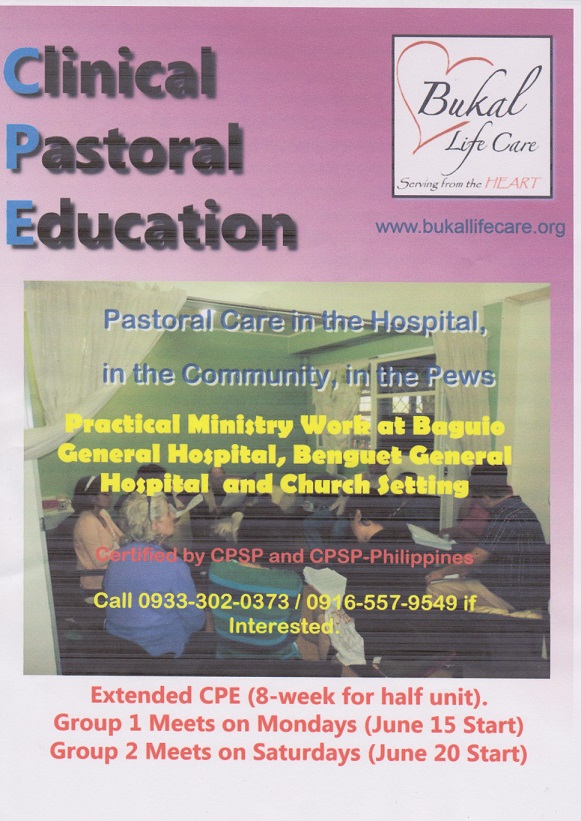
Clinical Pastoral Education is provided by Bukal Life Care, in parnership with the College of Pastoral Supervision & Psychotherapy (CPSP) and CPSP-Philippines. Our next CPE groups start in mid-June. Contact us at 0933-302-0373 or info@bukallife.org if you have any questions.

Disaster Response for Ministers

DR May 1“Disaster Response for Ministers” training. at PBTS in partnership with Bukal Life Care. This is part of PBTS’ “Summer Leadership Institute.” Dean Miller from the Baptist General Assembly of Virginia was the lead trainer. The focus was developing of relief response networks that are prepared to respond to disasters of a variety of kinds and relating to a variety of needs. It was a great time for learning and for sharing insights.

DR May B3aOn the right is Dean Miller, our lead facilitator/instructor. Additionally,, Bob and Jehny (from Bukal Life Care) assisted, particularly in giving overviews of disaster response chaplaincy as it pertains to crisis defusing (Bob) and Play and Art Therapy (Jehny)

Basic Program/Schedule of Events for Disaster Response for Ministers Training

Wednesday (May 13)
Before 2pm        Registration at Finance/Dorms
2pm 1st              Session/ Welcome/Intro
3:30pm               Break
4pm                    2nd Session
5:30pm               Dinner
Thursday
7:30am               Breakfast
8:30am               3rd Session
10 am                 Break
10:30 am            4th Session
12 pm                 Lunch
1:30 pm              5th Session
3 pm                   Break
3:30 pm              6th Session
5:30 pm              Dinner
Friday                            (Same Schedule as Thursday)
Saturday
7:30am              Breakfast
8:30am              11th Session
10:am                Break
10:15 am          12th Session/ Graduation/Certificates
11:30 am           Lunch

JUNE CPE

We plan to have a Clinical Pastoral Education training starting on June 23. This will probably be a half unit only. However, if some are looking for a full unit, we are open to discussing the possibility.

Group time will be for 8 Saturdays (for the half unit).

CPE is practical training for pastoral in a hospital and community setting. If you have any questions, contact us at info@bukallife.org.

Necessity of Theology and Ethics in Pastoral Care

A question can be asked as to whether there is a role for pastoral care. While pastoral care has centuries (millenia) of experience… the last 100 years has seen growth of alternatives for psychoemotional care.

Consider 6 possible (or at least potential) views regarding therapeutic care for those with psychoemotional problems. (These are listed by H. Newton Malony in “The Demise and Rebirth of the Chaplaincy” Journal of Pastoral Care, Vol. 29, 1975)

  1. Biophysical. The psychoemotional problems stem from problems with the physical body.

  2. Intrapsychic. The problems stem from bad mental processes/conflicts going on within the mind.

  3. Behavioral. The problem is bad learned habits that must be unlearned/replaced.

  4. Socioeconomic. The problem is the environment the person is in. It is necessary to change the setting.

  5. Meaning. The problem is that the individual has failed to gain a sense or purpose or meaning in life.

  6. Morality. The problem is conflict between actions and sense of moral obligations and social responsibilities.

Psychiatrists may be generally thought of when it comes to the first of these (mental care tied to medicine). Psychologists of different flavors may work primarily in the 2nd and 3rd areas. Perhaps social workers would focus in the 4th area. But who can handle the 5th or 6th areas?

It seems pretty obvious that those specializing in pastoral care (pastoral counseling, pastoral psychotherapy) should be the one’s prepared to work in these areas.

Why?

First, the concerns of meaning and purpose are essentially theological or religious concerns. Religion speaks to the great mysteries… Why am I here? What is my purpose? Is this all there is? Who am I? Theology reflects upon these religious questions. These can also be described as the issues of spirituality. Sadly today, “spirituality” often implies a vague pleasant mysticism, but “spiritus” has more of an idea of “empowered meaning” or “enlivened purpose.” Dealing with issues of meaning and purpose are clearly to be in the skill set of a pastoral care provider since it is the realm of religion, theology, spirituality.

Second, the concerns of morality or social obligation are issues of ethics, of axiology. Dealing with choices as they pertain to what the individual believes his obligations are to God, to society, and to “what is right” is certainly supposed to be the domain of one trained in religious or pastoral care.

But is this true?

Sadly, this often is not very true. Theological training for pastoral care providers is often quite weak. Much of the training of pastoral care is more in the first four areas… particularly in the 2nd area. Is that wrong? Well, it is not wrong that pastoral care providers be trained in psychological principles. But if the focus is so strong that their theological integration is poor, the result can be that a pastoral care provider is one who essentially practices psychology– but with less skill than a real psychologist. Additionally, there is a strange reticence to give moral guidance in pastoral care. Perhaps this is a reaction to those who are often all too happy to provide quick and easy guidance… often with an ethical base little above Biblical verse dropping.

Pastoral Care Providers need a solid, reflective, nuanced understanding of theology, particularly as it relates to meaning and purpose, and as it relates ot making wise ethical choices. Pastoral Care should follow the wisdom of Psalm 23 in gently leading/guiding. This contrasts the polemic approach of some in ministry. But it also contrasts with the Rogerian “client-centered” approach that fails to give external guidance.

Summarizing, a solid pastoral care provider needs a mature understanding of his or her faith within the context of sound psychoemotional therapeutic principles and methods. If this is the case, such a person is competent to deal with the 5th and 6th areas of psychoemotional concern… areas that others have little to no competence in.

One may want to read an old, but good, article.  Has Ministry’s Nerve Been Cut by the Pastoral Counseling Movement? by Gaylord Noyce (1978)