CPE Summer Intensive 2015 Graduation

May 29, 2015, we had our CPE graduation at Philippine Baptist Theological Seminary

DSC04993

CPE Trainees Summer 2015

Teresita Acdol

Jestoni Aduca

Dennis P. Alida

John Mark M. Bagalan

Arturo C. Balagot

Edgar Chan

Dionelle John B. Cornate

Sr. Rufina Dubao

Meriam G. Dulay

Mariz S. Eustaquio

A. R. Fabiala

Corina Mariano

Lalaine C. Mirasol

Rebecca Ann S. Pesquera

German B. Ramboyong Jr

Serafina Tenenan

CPE Supervisors

Celia P. Munson

Dr. Paul C. Tabon

Jehny M. Pedazo

Ptr. Renato Eustaquio, a 2007 CPE graduation and senior pastor at Vineyard Christian Church in Bocaue, Bulacan, was our guest speaker. Each trainee also gave their theological integration from the CPE term. Dr. Paul Tabon gave the commissioning at the end of the main service.

This was also the first time that Dr. Paul Tabon and Ms. Jehny Pedazo served as CPE Supervisors (SITs) under CPSP-Philippines. Good job!!

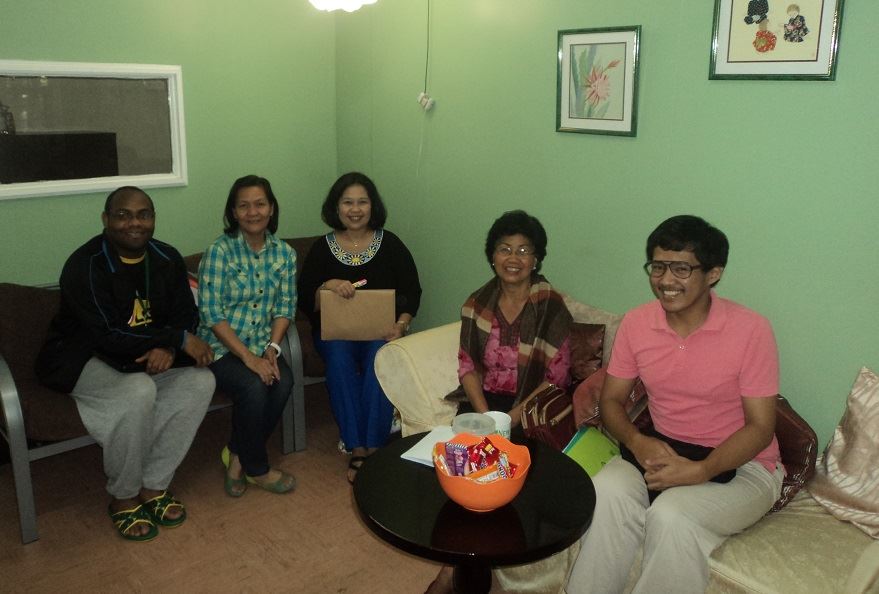
Afterwards, we moved a few feet from Chapel B to the Bukal Life Care office for lunch fellowship. It was a great day. Congratulations to all who have stayed true to finish the course. We are excited to see what God has for each in the future.

DSC04998 DSC05008

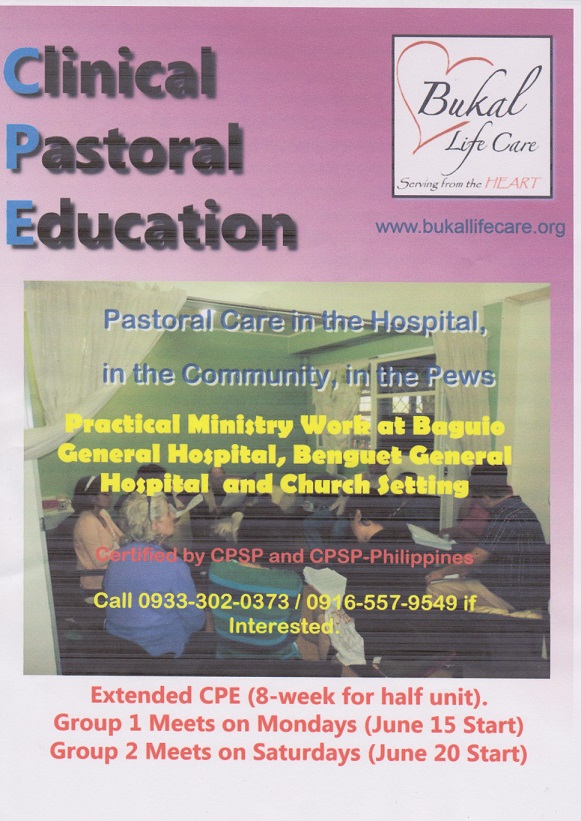
Clinical Pastoral Education is provided by Bukal Life Care, in parnership with the College of Pastoral Supervision & Psychotherapy (CPSP) and CPSP-Philippines. Our next CPE groups start in mid-June. Contact us at 0933-302-0373 or info@bukallife.org if you have any questions.

Necessity of Theology and Ethics in Pastoral Care

A question can be asked as to whether there is a role for pastoral care. While pastoral care has centuries (millenia) of experience… the last 100 years has seen growth of alternatives for psychoemotional care.

Consider 6 possible (or at least potential) views regarding therapeutic care for those with psychoemotional problems. (These are listed by H. Newton Malony in “The Demise and Rebirth of the Chaplaincy” Journal of Pastoral Care, Vol. 29, 1975)

  1. Biophysical. The psychoemotional problems stem from problems with the physical body.

  2. Intrapsychic. The problems stem from bad mental processes/conflicts going on within the mind.

  3. Behavioral. The problem is bad learned habits that must be unlearned/replaced.

  4. Socioeconomic. The problem is the environment the person is in. It is necessary to change the setting.

  5. Meaning. The problem is that the individual has failed to gain a sense or purpose or meaning in life.

  6. Morality. The problem is conflict between actions and sense of moral obligations and social responsibilities.

Psychiatrists may be generally thought of when it comes to the first of these (mental care tied to medicine). Psychologists of different flavors may work primarily in the 2nd and 3rd areas. Perhaps social workers would focus in the 4th area. But who can handle the 5th or 6th areas?

It seems pretty obvious that those specializing in pastoral care (pastoral counseling, pastoral psychotherapy) should be the one’s prepared to work in these areas.

Why?

First, the concerns of meaning and purpose are essentially theological or religious concerns. Religion speaks to the great mysteries… Why am I here? What is my purpose? Is this all there is? Who am I? Theology reflects upon these religious questions. These can also be described as the issues of spirituality. Sadly today, “spirituality” often implies a vague pleasant mysticism, but “spiritus” has more of an idea of “empowered meaning” or “enlivened purpose.” Dealing with issues of meaning and purpose are clearly to be in the skill set of a pastoral care provider since it is the realm of religion, theology, spirituality.

Second, the concerns of morality or social obligation are issues of ethics, of axiology. Dealing with choices as they pertain to what the individual believes his obligations are to God, to society, and to “what is right” is certainly supposed to be the domain of one trained in religious or pastoral care.

But is this true?

Sadly, this often is not very true. Theological training for pastoral care providers is often quite weak. Much of the training of pastoral care is more in the first four areas… particularly in the 2nd area. Is that wrong? Well, it is not wrong that pastoral care providers be trained in psychological principles. But if the focus is so strong that their theological integration is poor, the result can be that a pastoral care provider is one who essentially practices psychology– but with less skill than a real psychologist. Additionally, there is a strange reticence to give moral guidance in pastoral care. Perhaps this is a reaction to those who are often all too happy to provide quick and easy guidance… often with an ethical base little above Biblical verse dropping.

Pastoral Care Providers need a solid, reflective, nuanced understanding of theology, particularly as it relates to meaning and purpose, and as it relates ot making wise ethical choices. Pastoral Care should follow the wisdom of Psalm 23 in gently leading/guiding. This contrasts the polemic approach of some in ministry. But it also contrasts with the Rogerian “client-centered” approach that fails to give external guidance.

Summarizing, a solid pastoral care provider needs a mature understanding of his or her faith within the context of sound psychoemotional therapeutic principles and methods. If this is the case, such a person is competent to deal with the 5th and 6th areas of psychoemotional concern… areas that others have little to no competence in.

One may want to read an old, but good, article.  Has Ministry’s Nerve Been Cut by the Pastoral Counseling Movement? by Gaylord Noyce (1978)

Completion of Clinical Pastoral Orientation

11046403_10153105053377622_5584151572231003126_n

Congratulations to Keishon, Lalaine, Tess, and German in completing Clinical Pastoral Orientation. They are seated here on their final meeting with Celia (their instructor in the middle). CPO is a mini-CPE (about 1/4 of a full unit). It provides the structure and educational philosophy of CPE while set up to be more compatible with a Bible School or Seminary quarterly or tri-mestral program. For some, the program is enough to provide insight into pastoral care and into self, while for others, it provides a stepping stone to the regular Clinical Pastoral Education program.

Three of them will be starting Clinical Pastoral Education (CPE) on March 16.

Update on CPE Program

Clinical Pastoral Education (CPE) is a program of pastoral care training that was developed in the 1920s and has become popular worldwide. It develops individuals to integrate their role as pastoral care persons (whether as clergy or laity) that combines standard small group lecture with group process, individual supervision, and practical (“hands-on”) ministry. The venue for practical ministry is typically in hospitals (serving as a chaplain intern), but may also be done in jails, hospices, churches, and other settings.

The CPE done at Bukal Life Care is certified by the College of Pastoral Supervision & Psychotherapy (www.pastoralreport.com) and CPSP-Philippines (www.cpspp.org)

CPE is done in units.

  • Each unit consists of 400 hours, and takes (typically) about 11 weeks. The 400 hours consists of 300 hours of practical ministry and reflections, and 100 hours of formal training, group work and individual supervision.

  • A half unit consists of approximately 200 hours and takes (typically) about 6 weeks. The 200 hours is divided in a similar manner between practical ministry and other training modes.

Many religious and health institutions require, or at least recommend, that their workers have completed either half of a unit, or one full unit.

Cost Breakdown

  • Full Unit.

    • Supervisory Fee**             10,000 Php

    • Administrative Fee**            2,000 Php

    • Ministerial Support**           2,000 Php

                                          Total: 14,000 Php

  • Half Unit.

    • Supervisory Fee**              5,000 Php

    • Administrative Fee**          1,500 Php

    • Ministerial Support**          1,000 Php

                                                      Total: 7,500 Php

**Supervisory Fee covers the tuition and supervision cost for the trainees individual trainer/supervisor. Administrative fee covers cost of records, certificates, ID, snacks during training, and testing. Ministerial Support covers costs for onsite ministerial coverage, and outside trainers as needed.

NOTE 1: The amount charged does not cover transportation, food, or lodging of individuals

NOTE 2: Scholarship arrangements are sometimes available on a case by case basis. Need is the primary, but not only, criteria.

http://www.bukallifecare.org

What’s New in Summer and Beyond

<For the most part, this is a repeat of a post on the CPSP-Philippines website: http://www.cpspp.org&gt;

A few updates. As Summer is beginning here (Summer starts in March in the Philippines) a number of things are happening.

1.  Clinical Pastoral Care.  CPO (“Clinical Pastoral Orientation”), a shortened-form of CPE intended for professionals and Bible school students, is finishing up in Baguio. CPO has requirements that are approximately 1/4th of a Full Unit of CPE (and according to my calculations, that is 1/2 of the requirements of a Half Unit). It provides a taste of the philosophy and training structure of CPE for those who are curious… and can be taken for school credit in some places.

Additionally, our Foundations of Clinical Pastoral Care book in development has just pased the 100 page mark (finally). It is almost a year and a half in development… but it is rolling now. It seeks to integrate the methodology and insights of the modern CPE and pastoral care movements, with the insights and theological grounding of the historical pastoral care movement. Prayerfully, the first draft should ready by June. This will provide the text basis for CPO/CPC training.

CPO will start again, hopefully, in June or July, but this time in Bulacan. Will keep you updated. <Note: While CPE is certified certified by CPSP-PI in conjunction with the standards of CPSP, CPO is not. It is a training program under the standards of Bukal Life Care… following methodology and quality standards of the CPSP-PI CPE program.>

2.  Clinical Pastoral Education. CPE always seems to be a fluid thing since it is small groups driven by need and opportunity. However, it LOOKS like CPE will be held this Summer at:

  • Three locations in Manila
  • One location in Baguio  (Full unit starts March 16. Half unit starts 2nd week of April)
  • One location in Korea

3.  D.Min. in “Pastoral Counseling and Clinical Pastoral Supervision.”  This program is held in Central Philippines University, in partnership with CPSP and CPSP-PI. The program is new but on-going. We are excited by its potential.

4.  Disaster Response Chaplaincy. CPSP-PI, Bukal Life Care, and Philippines Baptist Theological Seminary, will be holding a 3-day intensive training in Disaster Response Chaplaincy May 13-16 (yes, it looks like 4 days… but the ends are cut off). One of the goals of CPSP-Philippines is to add a sub-specialty for Clinical Chaplains of Disaster Response Chaplain.

5.  CPSP-PI Standards and MOA. CPSP-Philippinesstandards have been disseminated for utilization by chapters, training centers, and CPE programs. They closely follow the standards set by CPSP. The Memorandum of Agreement between CPSP and CPSP-Philippines has been written up and is presently being reviewed by both parties. Hopefully, the final version will be done soon for signing. The MOA will ensure equivalency of programs and reciprocity of certifications between the organizations.

December 2014 Updates

Updates:
—January 5-7. Lide-Walker Conference. We will have our booth there… and we will have our grand open house of our new office. Hope to see you there.

—January 26. First day of Clinical Pastoral Orientation. Meets on Mondays for 6 weeks. 100 hours of practical ministry, formal didactic, group life interaction, and individual supervision. (May be taken by PBTS students for credit).

—March 23. First day of Clinical Pastoral Education (Summer Intensive). 11 weeks long. 400 hours for one full unit of CPE, 200 hours for half unit of CPE. Certified by CPSP and CPSP-Philippines. (May be taken by PBTS students for credit).

—May 13-16. Disaster Response Chaplaincy. 3 day intensive in principles of crisis response and team development for disaster. (May be taken for credit with PBTS).

If you have any questions, email us at bukallife@gmail.com... or call us at 0933-302-0373 or 0916-557-9549 or (074) 445-6344.

Our Office is Finally Open!!

DSC04510 DSC04511 DSC04513

December 12th was the first time our new office has been used officially. Dr. Lawrence, the General Secretary of CPSP (College of Pastoral Supervision and Psychotherapy) joined us to help train us in clinical pastoral care. We were very thankful for this help and support.