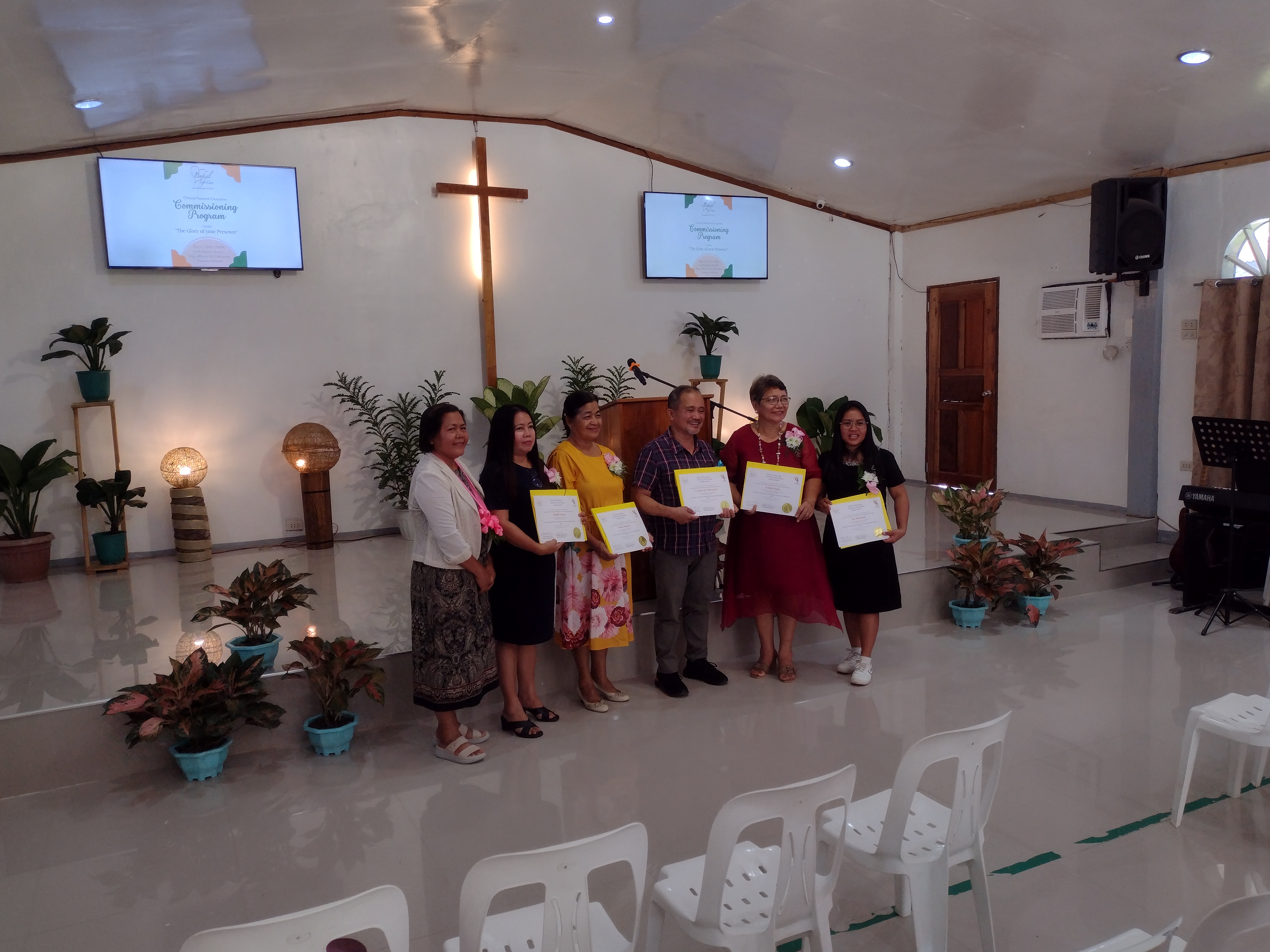
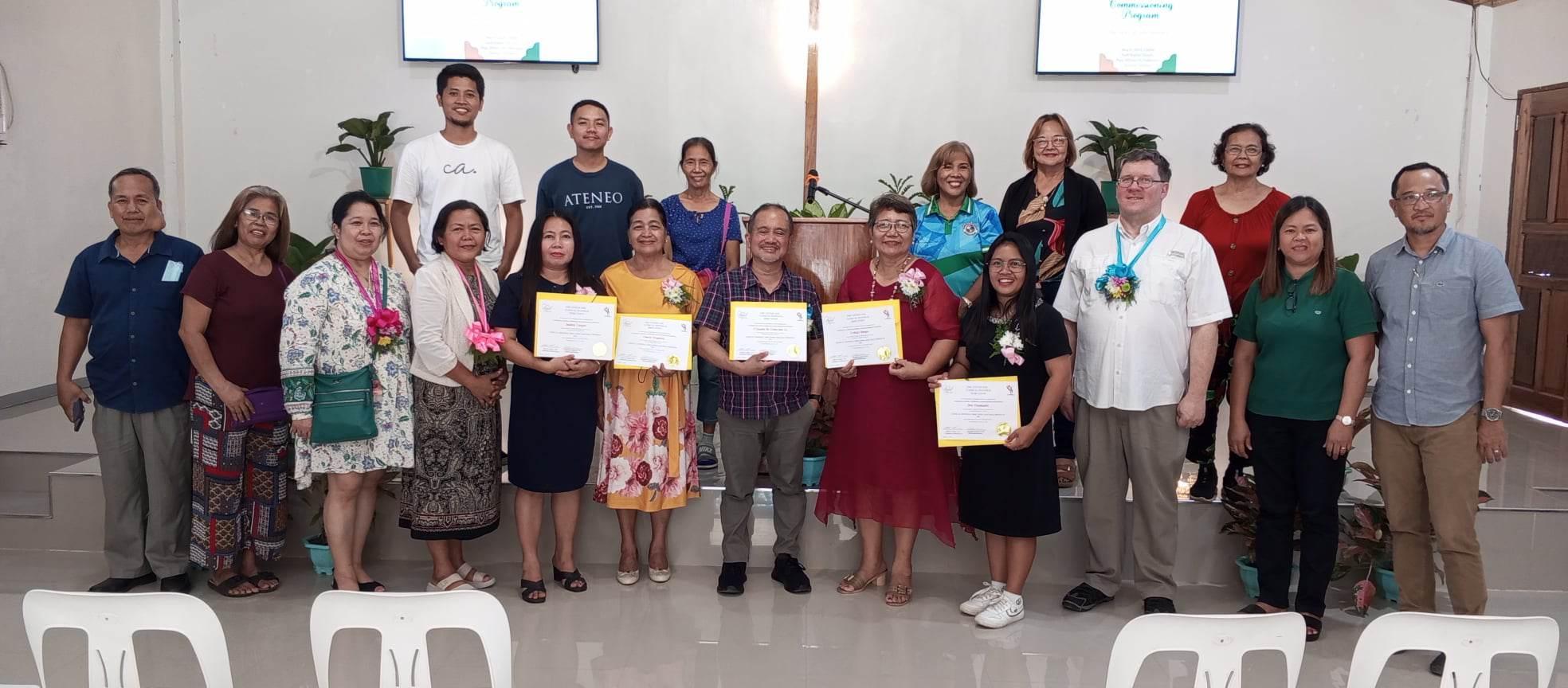
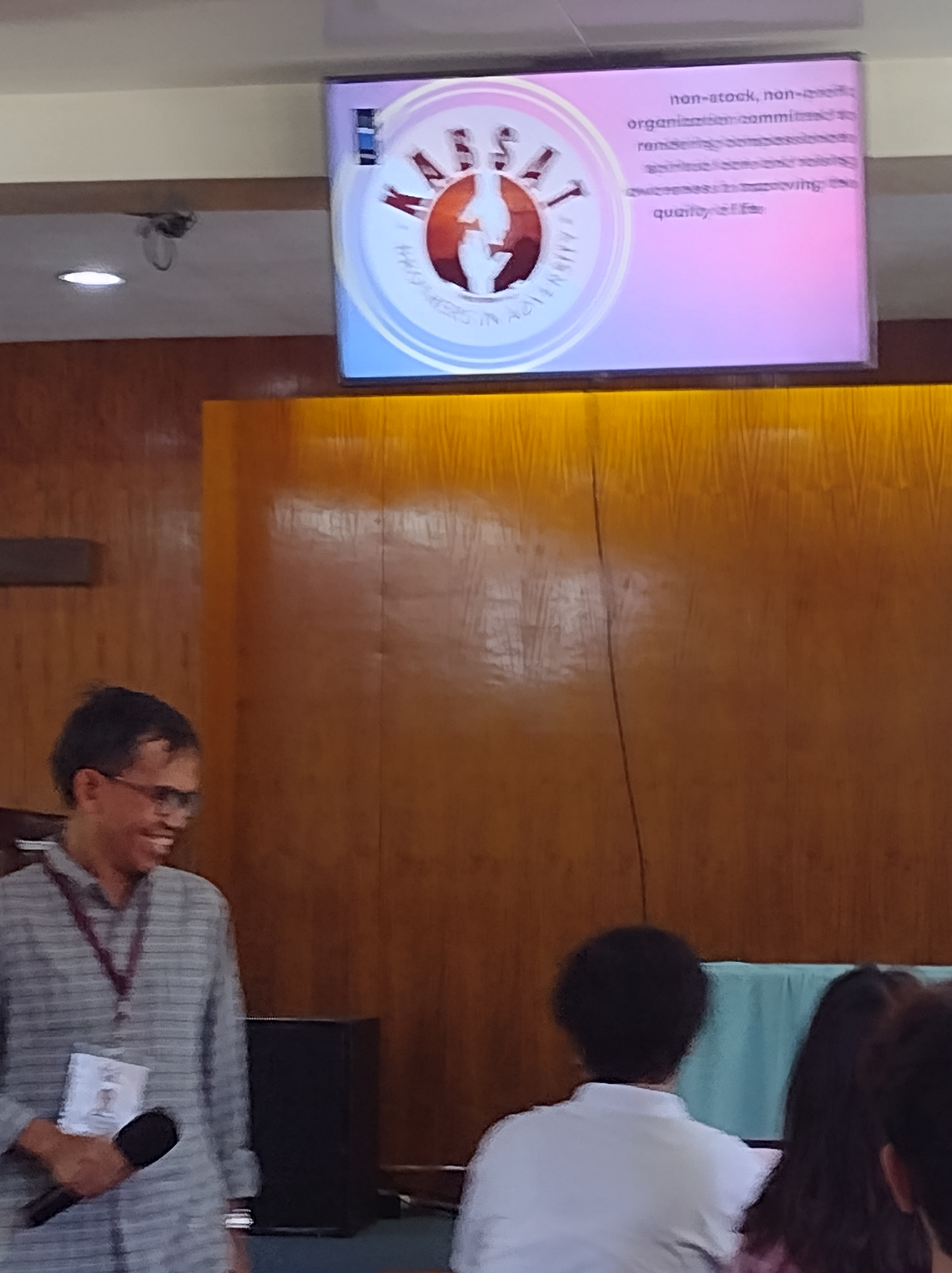
From Left to Right: Chaplain Jezza Pingo, Dr. Paul Tabon, Dr. Vic Navarro (on screen), Chaplain Vo Canoy, Chaplain Celia Munson, and Dr. Jun Vestidas
July 31, 2024, Bukal Life Care hosted a CPSP-Philippines certification board. We would like to congratulate Dr. Jun Vestidas and Ms. Jezza Pingo for passing their respective boards. The board is for a dual certification:
-Board Certified Pastoral Counselor (BCPC)
-Board Certified Clinical Chaplain (BCCC)
The members of the certifying board were Diplomates Paul Tabon, Celia Munson, and Vic Navarro (who joined online). Also participating was Diplomate Vo Canoy, who served as their endorser.
Both Chaplain Jun and Chaplain Jezza have been invited to join our Supervisor-in-Training (SIT) program and will soon be supervising CPE groups at Bukal. Upon completion of the SIT program, the two of them may seek a certification board for Diplomate In Pastoral Supervision.
The certification is with CPSP-Philippines and is recognized by our partner and parent CPSP in the United States.
We are excited for them as well as Bukal Life Care.
Our two Summer Intensive CPE groups will be finishing soon— one near the end of this month and the other early in August.
Here are a lot of things happening. Here are a few…
July 31. Certification Board for two of our trainees.
August 3. Training seminar in family systems . Central Philippines Nazarene College, Cebu City.
August 15. Counseling Project with The Salvation Army, NCR.
August 16. Start of Fall Extended CPE.
September 5 -6. Basic Pastoral Counseling Seminar. Quirino Province.
September 10. Start of Fall Intensive CPE.
November. Possible time of CPSP Plenary.
January 2025. Start of CPE groups in Baguio and Palawan.
We are happy to see the growth of ministry of our ministry partner– Australian-Filipino Community Services. Looking forward to expanded work with them… especially in training.
Well, we are in the middle of overlapping CPE groups. We presently have 18 trainees in multiple groups that will be finishing up in November or December.
Our next CPE groups are expected to start in January. Most likely these will be Face-to-face and Full units. It is possible one or more groups will be Extended and perhaps a Half unit will be offered. It really depends on the needs of the trainees and availability of the Supervisors.
Bob and Celia Munson will be in the US for a few months and while there will be teaching a course on “Types of Christian Counseling.”
Also, we are revamping our CPO program. Previously, it was set up to be 100 hours (ministerial and training hours) with the focus of working within a semestral school. While that may remain available, the updated version is more appropriate for the church or community setting. The present plan is:
-Training length 4 weeks
-Total hours 100
-Breakdown of hours Group Training: 36 hours (9 hours per week)
Individual supervision: 3-4 hours
Practical Ministry: Remaining hours
-Cases: 3 per trainee
-Supervision: SIT, or BCACC with supervision
-Structure: Follows the structure of CPE with lecture, practical ministry, individual supervision,
case presentation, and group work relations.
-Purpose: For some, to prepare trainee for CPE. Others, to have skill set for pastoral counseling,
and stress defusing.
-Texts: -“The Art of Pastoral Care” by Robert and Celia Munson
-Modified NOVA crisis defusing
-Handout and Visual presentations as needed.
-Practical Ministry Venues: Depends on the group… could be in church, community, or hospital
Dr. Lyn Montecastro’s CPE batch completed their unit, and held commissioning at Faith Baptist Church in Quezon, Palawan.
Dr. Bob Munson joined the celebration, as did Chaplain Celia Munson who acted as the inspirational speaker. Earlier we all went to Villa Esperanza Hardin for rest and refreshment.
We are blessed to have a door open to serve at Saint Louis University Sacred Heart Medical Center. In a few days our chaplains will start serving there, working with Fr Embry, the head chaplain of the hospital. The formal MOU is being worked on with signing coming soon.
We believe this is a great new opportunity for our chaplains, our chaplain trainees, and for the patients and staff of SLU Hospital.
Chaplains, Maricel, Vo, Celia, and Crista…. with Bob (administrator at Bukal)… and Dr. Quitaquit, hospital administrator, and Fr Embry, hospital chaplain.
SLU Hospital Foundation Day. It was great for the team to be invited.
Themed Floors at the Hospital during the Foundation Day Open House
On Monday, May 1, 2023, KABSAT, a holistic ministry organization based in Baguio City, held its first anniversary celebration. As a major partner of KABSAT, we have been working with them in counseling patients at Baguio General Hospital Cancer Center. We are thankful to KABSAT for the group’s focus on caring for the needy in Baguio.
Norm MacDonald recent passed away. I found him to be a great comedian, with the ability to be funny… even when it seems like he wasn’t trying to be funny.
A joke that he did was known as the Moth Joke. It was one of those jokes that wasn’t inherently that funny, but he could make it funny in telling it.
I want to use that joke, and revise it. I apologize for it probably not being funny— humor is not my expertise. However, I think the joke may make a point in this version.
One evening, Ptr. Jim was sitting at home reading. It was around 10pm and he hears a knock on the door. Perhaps Ptr. Jim should be more cautious this late, but he went to the door and opened it, and there was a moth.
The moth said, “I am sorry but I have been going through a lot. Can I come in and talk to you about it?”
This was new to Ptr. Jim, but he adjusted quickly and welcomed him into the living room. He said, “What should I call you?”
“Mr. Moth is fine. We really don’t have first names.”
Ptr. Jim said, “Well then, Mr. Moth, tell me what is going on in your life?”
“Well, you see I damaged my wing so I really have trouble flying.”
“Oh. I see how that can be a difficulty,” replied Ptr. Jim. “It sounds like you need some sort of professional medical help for that. I don’t know… an entomologist perhaps?”
“Something like that I suppose. But I am having trouble with one of my children. He does not return home before sunrise. Sometimes, he stays out all day. He has been failing night school, and with my wife and myself separated, I just don’t have the time or resources to take care of him as I need to.”
“Mr. Moth, that is a real challenge. Have you talked to the school principal or a social worker about this situation?”
“Well, No. And I have been so anxious lately. I do okay at work I guess, but I feel like everyone there thinks I am a fraud. I suppose it is ridiculous, but I hear people laughing at the office, I really feel sure it is about me.”
“That must be hard for you. You may need to talk to a psychologist— a moth psychologist I guess. But tell me, Mr. Moth, I am not an entomologist, or a social worker, or a psychologist. Why did you come to me?”
“Because your porch light was on,” responded Mr. Moth.
Yes that long joke was all to get to the (perhaps) humorous point that moths are attracted to porch lights. However, I think there can be a point to it as well. Pastors, pastoral counselors, and chaplains are part of a helping ministry. Part of this may be in strictly religious things—- rites, sacraments, and dogma within the church— especial for pastors. Pastors, pastoral counselors, and chaplains may also deal with issues of morals and ethics, as well as the great existential or religious questions that have challenged mankind for millennia.
But people will commonly go to these religious professionals for a wide variety of concerns beyond these, and will go to them long before going to a professional who specializes in the exact concern they have. There can be different reasons for this. For some, the religious care provider is thought of as one who is trustworthy when they are not so sure about others. For some, it is that they see the religious care provider as one who can help “for free.” For still others, the fact that they share a common faith a worldview is important. Finally, it may simply be that they know the local pastor or chaplain, but do not know the other specialists.
Regardless, this opportunity does lead to some responsibilities:
Being trusted is nice, but religious care providers need to ensure that the trust is earned. If others trust, one should be trustworthy— trustworthy in terms of professional ethics especially.
Being honest in one’s limitations. No one is good at everything. A religious care provider should know his or her own limitations and know who and how to refer clients or members to others. It is not weakness to recognize limitations. Going to secular specialists is not suggesting superiority of these. Rather, most people would do well with working with the religious care provider AND one who specializes in the are of the problem.
Being trained to be competent. Since people will come with a wide variety of problems, it is good to have basic competencies. It is good to refer to experts… but the pastor, pastoral counselor, or chaplain is often a bridge between the one in need and these. The religious care provider should be prepared and practiced to provide support in a wide variety of areas. In fact, a properly trained religious care provider can take care of many many problems (but not all problems) without bringing in specialists. This requires intentional training and mentoring/supervision.
Religious Care Providers should be prepared for anything. One never knows who will see your porch light on.
Oh yeah… and one more thing— There is also an interesting article (opnion essay in the NY Times) on Norm MacDonald as a comedian who was a Christian, but who did not market himself as a Christian comedian. You can read it “Norm MacDonald’s Comedy Was Quite Christian.”
In sports recently, the issue of mental health has been a matter of focus. It began in the Olympics with Simone Biles. Then Michael Phelps brought his own perspective. More recently Naomi Osaka has reenergized the discussion with Tom Brady adding his thoughts, among many.
Many sports fans, and some sports commentators have been… less than sympathetic. This is hardly new. Roberto Duran was castigated by his fans (and foes) for “giving up” in his with Sugar Ray Leonard. Although he claimed he quit because of stomach cramps, many people saw it as a sign of weak character.
Some of this, however, is how it is framed. If Duran went back in the ring and allowed himself to be knocked out (perhaps taking a dive, perhaps just allowing his physical problem to play out) he probably would not have gotten as much grief. If Biles expressed her problems as being more physical than mental, or if Osaka had expressed things in terms of family issues or wanting to take a break, perhaps the responses would be different.
We have generally gotten comfortable with athletes “quitting” due to physical injury. We have also gotten somewhat comfortable with sports stars taking a break due to grief (such as death in the family). Less slack is given for issues of relationships and psychoemotional problems. Perhaps people are least in understanding of problems that come from what I might call spiritual problems. What I mean by that is struggles in terms of purpose, ethics, and character.
What can we say in response to this? I would suggest two things that, unfortunately, are somewhat in conflict with each other.
Thought #1. It is good to be able to speak honestly about one’s brokenness. It is good that one does not feel the need to make up fake reasons for struggles, or hide the struggles. Healing comes from identifying one’s brokenness and acting on it honestly. Deception, and especially self-deception, does not bring healing. Additionally, bringing problems out into the open can be good for other people, to come forward and get the public to talk about these issues.
Thought #2. As good as it is to talk honestly about one’s brokenness openly, it can be self-destructive to share with people who are judgmental or in other ways toxic. It is good to share with those who are trustworthy.
Ideally, one should find people that one can trust to talk about one’s areas of brokenness. For celebrities, this can be tough. Far too many people are invested in their lives. We call these people fans, but fans (derived from the term fanatic) are often not trustworthy people.
Religious leaders can also have the same problem. Some religious leaders are put up on a pedestal. It is difficult to talk about their spiritual brokenness (issues of purpose, ethics, and character). Both friends and foes can be toxic. It can be even a bigger concern in faith communities that spiritualize physical, relational, and psychoemotional problems (seeing them as sinful, or the result of personal sin).
We think of Heaven as a place of absence of problems or brokenness. That may be accurate. However, I would like to suggest a different image of Heaven. Heaven is a place of absolutely trustworthy relationships– a place where brokenness can be shared freely and openly because everyone will respond in a way that is supportive and therapeutic. Heaven is then a community of healing.
The Bible says that there is a day coming when Heaven comes to Earth— but that day has not yet arrived. We live in the tension between the two thoughts above. It is good to be open and public, but sharing with untrustworthy people causes serious problems.
For religious leaders, the following suggestions are worth considering:
Have a network of supporters (not fans). Supporters hold people accountable. Supporters listen and respond therapeutically.
Don’t put oneself on a pedestal. Others are less likely to do it if one does not do it oneself. Don’t try to put on an air of invulnerability or perfection.
Train one’s flock properly. Do not teach toxic theology that is more focused on judging than healing. Help them struggle with issues of theodicy and sin with wisdom.
Don’t be afraid to seek professional help. That is a sign of strength not weakness.
There will always be unhelpful friends and foes… but one can minimize their effect, allowing one to be publicly broken.
This was written several years ago, but some tiny changes were made to it as it was resubmitted to academia.edu, so decided to provide a link to it for those interested.
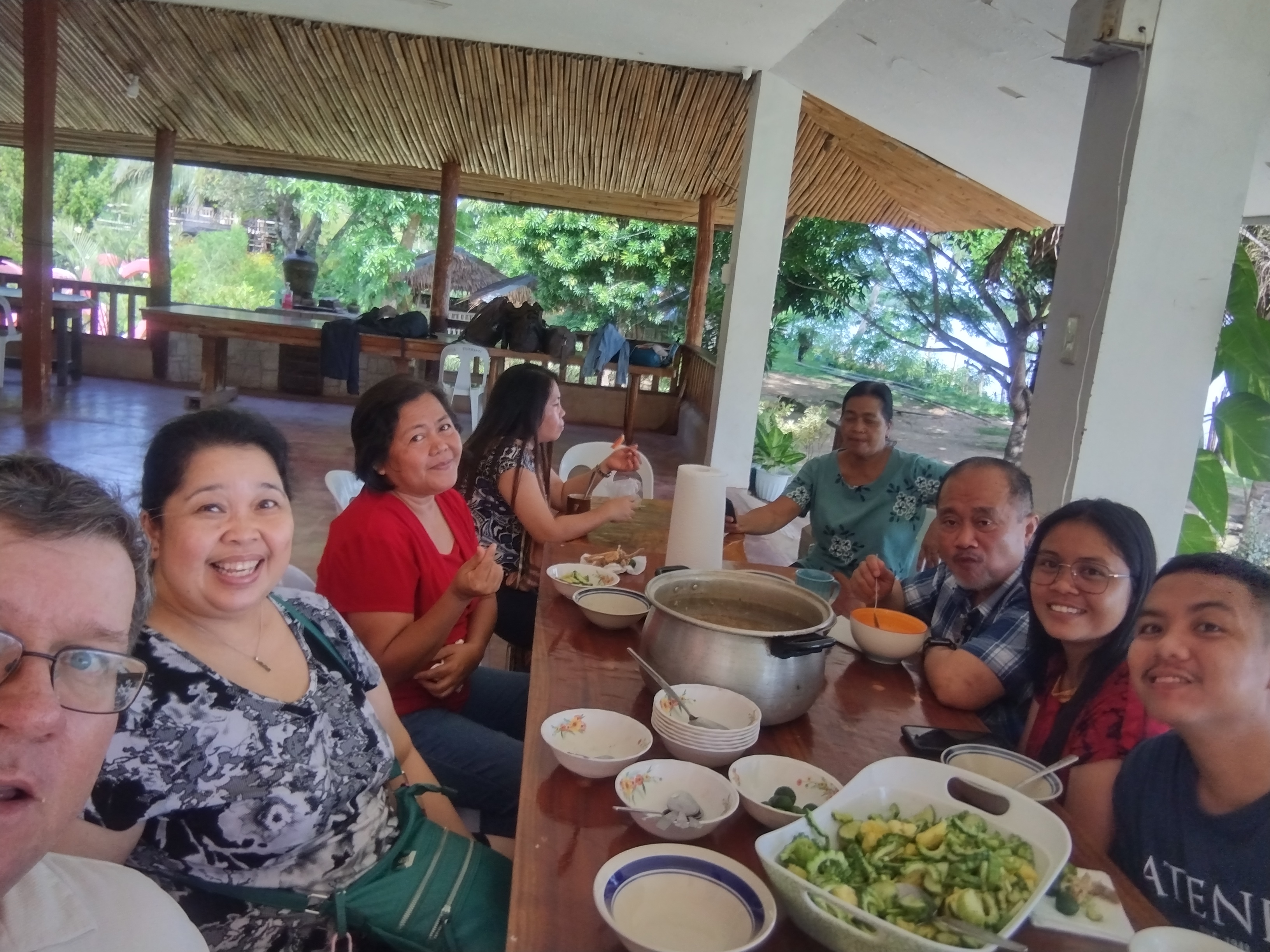
This is a picture of our CPO (Clinical Pastoral Orientation) group at Mang Inasal Restaurant for debrief after hospital visit at Baguio General Hospital for chaplaincy training.









 Bukal Life Care