What’s in a Name

Okay, it is a bit confusing. Some places we call ourselves the following:

Bukal Life MinistriesBukal Logo Small New
Bukal Life Care & Counseling Center

Bukal Life Care & Training Center

Bukal Life Care

Perhaps the following will correct the confusion.

1.  Bukal Life Ministries. When we first formed as a group in October/November of 2009, this was the name that we went by. BUKAL is the Tagalog word for “spring” (as in a fountain of water). We felt the name fit our focus on helping people recover from Tropical Storm Ondoy and Typhoon Pepeng.  Even after our name officially changed, we retained the name “Bukal Life Ministries” for projects that were tied more to social ministry (as opposed to pastoral care or clinical pastoral education). So, in a sense, we never retired the term.

2.  Bukal Life Care & Counseling Center. When we incorporated in June of 2010, we utilized the name “Bukal Life Care & Counseling Center.” The term counseling implied related to our pastoral care and clinical pastoral education work. The term care focused on the social ministry and training work. This has been our official name up until the present.

3.  Bukal Life Care & Training Center.  In November 2012, concerns about the use of the term Counseling Center came up. It was felt by some that the term “Counseling” was inappropriate based on Philippine Republic Act 9258. Based on that, there was a decision to research a name change removing the term Counseling and replace with Training. That actually made sense since it could be said that implied two basic ministries “Life Care” and “Training.”  So we started making changes towards the name change. That stopped based on a reevaluation that we did not violate the Republic Act. <Frankly, the law is quite… curiously…  written. The law professionalizes the use of the term “counseling” but fails to recognize many common uses of this common term, only recognizing  psychoemotional counseling. As such it ignores legal counseling, spiritual counseling, informal counseling, professional/vocational counseling and so forth. The Law also criminalizes the use of the term “center” but doesn’t technically clarify that the such criminalization only relates to psychological counseling organizations. However, one has to appreciate the spirit of the law that seeks to professionalize a noble activity.> Gradually we started moving away from this name.

4.  Bukal Life Care. We often have used this term as the short form or our organization. A number of us have considered the possibility of changing our name formally to this short-hand title. It gets rid of the term “counseling center,” which causes so much confusion in the Philippines. Secondly, it focuses on our main role “LIFE CARE.” Life Care is the term we use for the following sub-topics (both as an activity and as a training are):

Pastoral Care/Spiritual Care

Member Care

Crisis Care

Health Care


Our board of trustees will be meeting in a few weeks to come up with a final name. We will let you know what is finally decided.


“The Cup Analogy” of Emotional Pain

There is a cup of water sitting on a table. It is so full, it is rounded at the top. One or two drops of water are added to the cup and it spills over. What caused the water to spill? We want to blame the last one or two drops, but in an empty cup it would not spill. It was not the water in the cup prior to the drops being added, because if left alone, it would not have spilled. It was a combination of all the drops of water in the cup that came before and the last one or two drops that caused the water to spill. In a person’s life, the water in the cup is symbolic of all the hurt, pain, shame, humiliation, and loss not dealt with along the way. The last couple of drops symbolize the “trigger events”, “the last straw”, the event or situation that preceded the final act of taking one’s own life.
Often we want to blame the trigger event, but this does not make sense to us. Like the water, these events all by them selves would not cause someone to end their life. It is the combination of everything in that person’s life not dealt with and the last one or two things that caused our loved ones to lose hope. For us, we must find a way to pour out the water along the way. This may be through talking it out, writing it out, sometimes yelling it out, whatever works for you. We must learn to deal with our pain in a way our loved ones could not.
This analogy does not give us the concrete answer many of us are looking for, but I know it made sense for me and has been helpful for many survivors. It allowed me to let go of the search for “why”, and to find a different way of dealing with my pain.

                    —Tracy T. Dean, M.S

CPSP Farrell Symposium. October 25-26, 2013

2013 Annual Viola and William Farrell Symposium on Pastoral Care & Counseling. At Philippine Children’s Medical Center. October 25-26, Quezon City. See Flyer.

seminar 2013

Persons with Disabilities and Family

Celia Munson, Training Coordinator and Pastoral Counselor with Bukal Life Care was invited to speak at “Area 1 Vocational Rehabilitation Center” (AVRC) for their Family Thanksgiving Celebration. The topic was on Unity/Solidarity of family and members with disabilities. The center presently has 57 trainees with sensory or physical disabilities. The center, operated by the Department of Social Welfare and Development, trains people with disabilities in numerous areas including tailoring, hairdressing, massage, computer, food service, and more.

Approximately 100 attended this event. We have worked with AVRC before and it was an honor to be invited again. Celia spoke on issues of family dynamics as well as a number of group activities to show the importance of healthy family cohesion and flexibility.


DSC03268DSC03279

Caring for Those that Care

Caring for others is a joy and a struggle.

Quoting from the ProQOL.org,

Professional quality of life is the quality one feels in relation to their work as a helper. Both the positive and negative aspects of doing one’s job influence ones professional quality of life. People who work in helping professions may respond to individual, community, national, and even international crises. Helpers can be found in the health care professionals, social service workers, teachers, attorneys, police officers, firefighters, clergy, airline and other transportation staff, disaster site clean-up crews, and others who offer assistance at the time of the event or later.

Understanding the positive and negative aspects of helping those who experience trauma and suffering can improve your ability to help them and your ability to keep your own balance.“

On the positive side of caring is Compassion Satisfaction. Most of us feel good when we help (or try to help) someone in need. However, there is a negative side as well. Negative results of caring include:  Compassion Fatigue, Burnout,
Secondary Traumatic Stress. Primary Traumatic Stress, and Vicarious Traumatization.  Understanding these issues can be helpful in a caregiver. Early recognition of burnout or traumatic stress can lead to useful treatment in refreshment, renewal, and transformation.

A simple test that is freely made available by ProQOL can be used for compassion satisfaction, burnout and secondary traumatic stress. It is available in many languages.

Click on http://www.proqol.org/ProQol_Test.html to get the test, and manual, and guidance on use.

Products from Jail in Baguio and Benguet

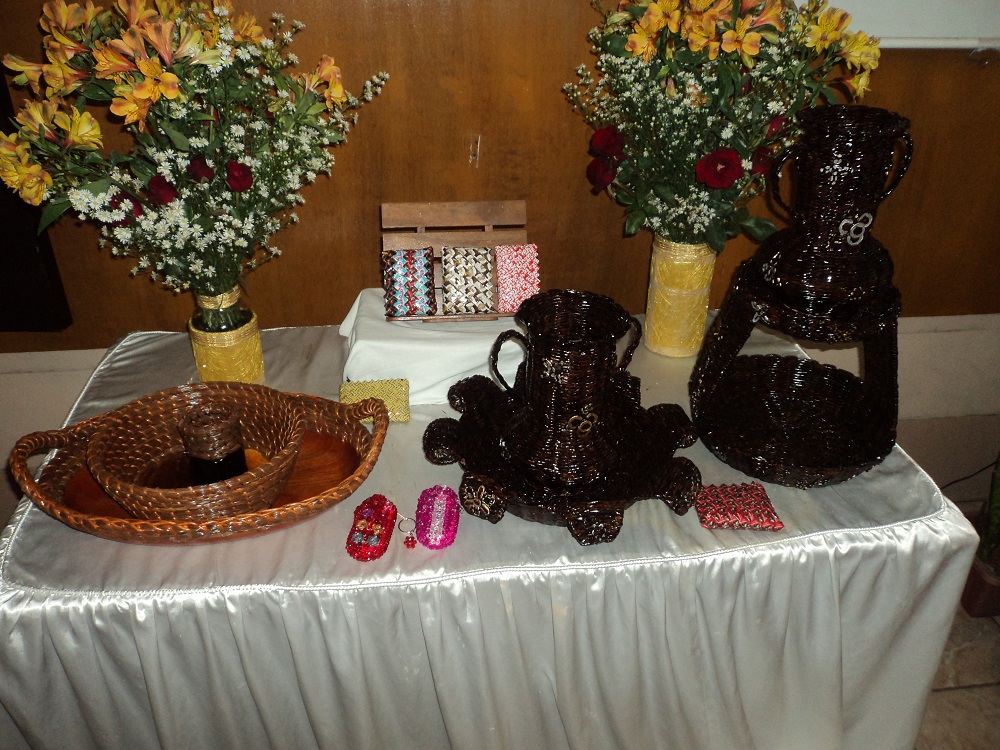
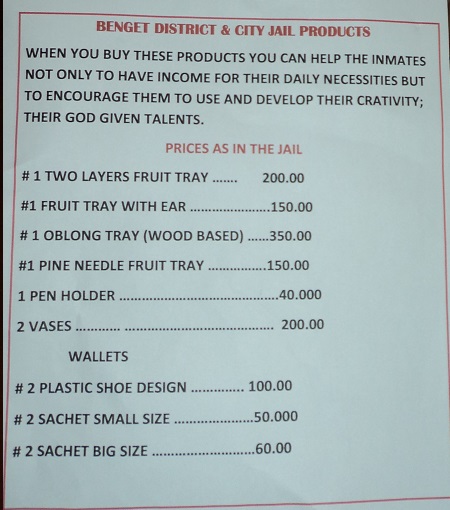
Some of our Chaplain Trainees have been working with the Baguio City Jail and Benguet District Jail (La Trinidad). They asked if we could put some of the products produced by the inmates (as part of their retraining and income development) would be put on the Web. The items that are brown look like they are wicker, but are actually skillfully made from tightly rolled-up newspaper. You would be amazed at some of the products and how they are made from things most of us throw away. We own a beautiful swan sculpture picture frame made at the Baguio City Jail from gum wrappers. It is inspiring and reminds us how God takes people the world has “thrown out” and makes something wonderful and new from their lives.

We are not a store (and don’t plan to become one anytime soon). Still, we are wholeheartedly in support of helping the inmates in their wholistic growth and rehab. If you have any questions about the products, please forward them to us at info@bukallife.org, and we will gladly forward them to Sister Tammy.
Jail Products 1

Jail Products 2

Bukal Life Care (General) Brochure 2013

<div style=”margin-bottom:5px”> <strong> <a href=”http://www.slideshare.net/bmunson3/bukal-life-care-2013&#8243; title=”Bukal Life Care 2013″ target=”_blank”>Bukal Life Care 2013</a> </strong> from <strong><a href=”http://www.slideshare.net/bmunson3&#8243; target=”_blank”>Bob Munson</a></strong> </div>

Missionary Member Care Trainings

Member Care Class 2

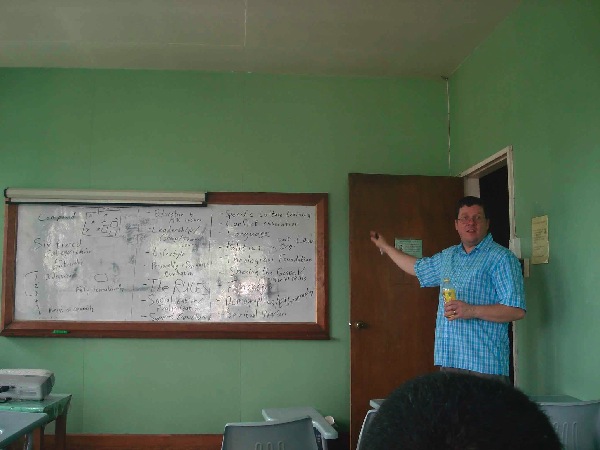
Dr. Bob Munson (Administrator of Bukal Life Care) is finishing up teaching of Missionary Member Care at Summer Institute of Philippine Baptist Theological Seminary. There are 13 in the class.

Arquillano Training 1

Ptr Arnold Arquillano is shown here at Missionary Member Care Training done with One Sending Body. He and his wife Rose, friends and partners of Bukal Life Care, learned a great deal about missionary evaluation and training. We hope to grow our expertise in this context to improve our help of missionaries and other ministry professionals.


Supporting Missions by Supporting Missionaries

One of our growing areas of work has been in the area of Missionary Member Care. For those who do not know, Missionary Member Care (MMC) deals with the logistical, emotional, mental, physical, social, and spiritual aspects of mission work. As a pastoral care and counseling center, we don’t have much to do with certain aspects of MMC, but have much we can do in other areas.

One organization we have been assisting is Asia Vision Short-Term Missions (AV-STM). AV-STM was founded back in 2003 and sends out teams of Filipinos and Asians on short-term and mid-term mission trips in Southeast and Central Asia.

For 2013, we have been able to assist in a few ways:

  • Jehny has been able to do personality evaluations to assist members in self-understanding and team dynamics
  • Celia provided training in basic first aid and health issues while on mission.
  • Joyce provided training in conflict resolution
  • Our team provided First Aid kits and vitamins for the mission teams
  • If needed, we will provide post-trip debriefing

Bob will be teaching Missionary Member Care at Philippine Baptist Theological Seminary this May. It is our hope that we will gain greater competence in the myriad of challenges associated with missions work.

Those who commit to serve in a missions capacity are “too valuable to lose.” For information on AV-STM, Click Here