
The CPSP wrote a tribute to Nars Dumalagan regarding his great role in building CPE in the Philippines and Southeast Asia. Click on the link below.
Category Archives: Commentary
Denominational? Non-denomination? Ecumenical? Interfaith?
We get a fair bit of confusion regarding who we are with respect to issues religious denomination and faith. Maybe this will help somewhat.
1. Bukal Life Care & Counseling Center is “Non-denominational.” That means that we, as a group, do not ascribe to a single denominational creed, nor require our members to be a member of a specific denomination.
2. Members of Bukal Life Care & Counseling Center (staff, supervisors, board members) are members of different denominations/churches and are expected to serve within their faith communities. Thus, members are expected to serve “Denominationally” within their church setting, but are expected to serve non-denominationally with Bukal Life.
3. Bukal Life Care & Counseling Center is also “Ecumenical.” This term has different meanings to different people. We understand the term to mean sharing in a common Christian faith. For us, we ensure this by requiring members of Bukal Life to concur with the Apostle’s Creed… an early historical encapsulation of the Christ faith.
4. The College of Pastoral Supervision & Psychotherapy (CPSP) and Clinical Pastoral Education (CPE) are “Interfaith.” Interfaith means that the CPSP and CPE does not limit themselves to those of the Christian faith. Rather involvement as trainees within this group and program can occur regardless of their faith/creed/religion.
5. Bukal Life Care & Counseling Center, is a non-government organization (NGO) based in the Philippines. The College of Pastoral Supervision and Psychotherapy (CPSP) is a separate organization based in the United States. CPSP-Philippines is a separate organization linked with the CPSP but based in the Philippines. Thus, these are three separate organizations. Bukal Life is connected with the CPSP and CPSP-Philippines through mutual agreements, but are legally independent.
Since Bukal Life is a training center for CPE as certified by the CPSP, we provide CPE training to all and do not discriminate based on the religious faith of the trainees. However, Bukal Life carries out other ministries within the context of non-denominational historic Christian faith.
Special Needs Parenting
Special Need Parents have it difficult. Often it is even more difficult in the Philippines. The support system is spotty at best. The school system, even where it does accommodate special needs children, is overcrowded, teachers overworked, and children are put together in the same classroom who should not be. There is also a cultural tendency to keep special needs children hidden away at home. 
Much of these problems are world-wide. With that in mind, here is a blog article that we think you might enjoy. It is called “11 Things I’ve Learned Since Becoming a Special-Needs Parent.” Here are the first three items. To read the rest, click on the article at the bottom of this post.
1. Not knowing is a lot harder than knowing. Yes, there is a lot we can do via therapy to help our children walk, talk, learn, etc. But the hardest thing to admit is that most of it is simply up to their brain and its wiring. There are no certain predictors that a special needs child will develop speech, be able to read, be potty-trained, or become self-sufficient . Good signs, yes. But nothing is certain. The not knowing can drive you crazy if you let it.
2. The internet is a blessing and a curse. On one hand, there is valuable information out there. Yet, information overload can get you stuck. You end up reading too many awful things — that often don’t apply to your child at all — and it can deplete your hope and make you paranoid.
3. Connecting to the special-needs community (whether it be acquaintances, support groups, or the internet) can be both a lifesaver and bummer. It is vital to find people who know what you are going through. Yet, sometimes it can produce even more negative feelings. Since there is always someone who has it worse than you, it can make you feel guilty for complaining. And, since there is always someone else who has it much better, you can sometimes forget that, when it comes to parenting, stress and worry are relative. Those people are just as immersed in their concern over their children as you are and, understandably, aren’t grateful simply because it could be worse. It can always be worse.
To Read More, Click on THIS ARTICLE
Clarification
We have been getting some inquiries regarding residential counseling and care services. So as a point of clarification:
1. We do not have residential services. Our present services are limited to outpatient counseling in Baguio and Manila (and soon to add Bacolod). Questions regarding outpatient counseling sessions may be made to 0933-302-0373.
2. Additionally, we do chaplaincy services as part of our CPE and CPO programs at a number of places. These include (but are not limited to) hospitals (such as Benguet General Hospital, Baguio General Hospital, and Philippine Children’s Medical Center) and detention centers (such as Baguio City Jail).
3. We should note that we are in the VERY EARLY stages of discussion regarding setting up a Residential Counseling Center in the Baguio City area. However, it does not exist at this time and cannot promise when (or if) it will be done.
Article on CPE and Disaster Response training
Please look at this link. It is an article suggesting that CPE (Clinical Pastoral Education) is the best preparation for disaster response. This is opposed to the conventional wisdom of the 2-5 day crash training course.
Of course, since CPE is 400 hours of training per unit, it really should be more than a 30-40 hour total time course. Still, would love to hear your thoughts.
Testimony: Jehny Pedazo
There are a lot of needy people with troubled souls who need to be actively reached. This became clearer to me once I started pastoral or spiritual counseling in Clinical Pastoral Education (CPE); and through my affiliation with BUKAL Life Care and Counseling Center (BLCCC), serving in jail, hospital, school, church and community. Yes, counseling needs a missionary approach for its value to be fully acknowledged by the public as an indispensable resource. In the Philippine setting the term “counseling” still has a slight stigma attached to it because people have the idea that one goes for counseling only for mental and emotional disturbances. In order for the negative connotation to be dismantled, counselors ought to engage the general population and dispel these notions. I, for one, committed myself to pastoral counseling because I know what it feels like to be in great need of guidance yet ignorant and fearful about who to approach and trust. The times I faced crises, especially in my younger years, helped me know how helpful it would have been to receive counseling from someone who had dedication, sense of mission and good training.
It’s vital that counseling is delivered as a service accessible throughout the human lifespan because it is not only school-age children who need to be guided. At all phases of life, assistance in reflection; encouragement, and; informational services related to the counselee’s issues is essential to selecting best options in life. It is better if counseling is recognized as a lifelong resource, not merely “kid’s stuff.” Even adults and the elderly should feel comfortable to seek such help when necessary.
Healthcare services are trending towards the emphasis on prevention, including in counseling. It may be cliché to state that: “Prevention is better than cure,” but it holds true in any case. Soul ailments are not unimportant occurrences that we can be set aside without significant consequences. They must be addressed along with physical health. Through prevention we mitigate avoidable crises and the toll it takes on the individual, his family and others .
Now, in the Philippines, with licensure implemented, counseling has become a regulated profession. That is good in the sense that those who practice it can gain standard, credible qualifications. Counselees ought to receive the most professional and ethical guidance available. But passing licensure exams, getting continuing education, and having credentials does not guarantee that the counselor has therapeutic impact. In like manner, becoming a licensed physician does not assure that one is caring and beneficent to patients. I believe the competent counselor is one who applies wisdom in his own life, although not perfect, and utilizes his own challenges to minister to others’ needs. However, it’s also vital to the counselor to be part of an organization that continually motivates him to upgrade his counseling know-how.
It’s now 2011. I bet counseling still has a long way to go in the improvement of its services and delivery. I’m glad to be part of a counseling center, BLCCC caters locally to my own countrymen and is affiliated internationally with a larger organization, the College of Pastoral Supervision and Psychotherapy (CPSP). I actually shifted my studies to prioritize counseling subjects although my MA in teaching major is in psychology and my BS degree is in nursing. This is because I strongly believe in the great value of encouraging words, and moral support, to a person’s being. Calling and self-actualization trumps monetary gain. I can bear with material limitations for now, but self-fulfillment is a constant longing and it must be appeased before practical living concerns.
When I was deciding on a Masteral course, I chose my major because I wanted to specialize in my own passion, psychology, since from a young age I’ve always wanted to know how the mind works. My plan was to merge my undergraduate degree with my Masteral degree and become a psychiatric nurse. Now, however, I feel called to pastoral counseling in this season of my life. I’m enjoying the fulfillment and “sense of this is me” despite challenges at home, at work and in me. I don’t know what my future in counseling entails. I leave my fate in the all-encompassing protection, responsibility and love of God; although uncertainties can be troubling if I let them worry me. But as for the future of counseling in general, I’m optimistic that its positive developments and influences shall be far-reaching.
<Jehny is a CPE trainee with Bukal Life, Master’s student at University of the Cordilleras, and our Ministry Coordinator>
Doubters Welcome
25 During the fourth watch of the night Jesus went out to them, walking on the lake. 26 When the disciples saw him walking on the lake, they were terrified. “It’s a ghost,” they said, and cried out in fear. 27 But Jesus immediately said to them: “Take courage! It is I. Don’t be afraid.” 28 “Lord, if it’s you,” Peter replied, “tell me to come to you on the water.” 29 “Come,” he said. Then Peter got down out of the boat, walked on the water and came toward Jesus. 30 But when he saw the wind, he was afraid and, beginning to sink, cried out, “Lord, save me!” 31 Immediately Jesus reached out his hand and caught him. “You of little faith,” he said, “why did you doubt?” 32 And when they climbed into the boat, the wind died down. 33 Then those who were in the boat worshiped him, saying, “Truly you are the Son of God.” Matthew 14:25-33 (NIV)
Many people say that faith is the opposite of doubt. Certainly looking at verse 31 here, this appears to be the case. Yet many people who are thought of as pillars of the Christian faith throughout the history of the church were perplexed by nagging doubts. In fact, to doubt our ability to fully comprehend truth without error seems normal and human given the finiteness of our experience, knowledge, and reason.
Maybe the problem lies in our definitions of faith and doubt. Think of Faith as certainty of the will or volition. Lack of doubt is certainty of the mind or cognition. One has to do with decision-making, one with thoughts and ideas.
We are saved by Faith in Christ, not in lack of doubt. No wonder James said that faith without works is dead. It is not that faith is not enough, needing to have works to tip the scales in our favor. No. Lack of actions is inconsistent with a decision to live by faith.
In verse 31, the Greek word translated “doubt” would be more literally translated, “double standing” or “double minded”. If faith means your will is focused to do and be one thing… its opposite is a will that is not… it is divided… double.
Let’s look at the story of Peter and Jesus. When Jesus said to come, Peter got up and climbed out of the boat. What was the state of his mind at that point. His great faith is shown by his decision to climb out of the boat. However, since he had never walked on water before in his life… he must also have had much doubt in his thoughts.
More Faith + More Doubt resulted in walking on water
The passage further states that as Peter was walking he began noticing the rough waves and began to sink. He wavering in his faith. But he certainly had less doubt than before, since it is easier to think you can walk on water if you have done it and are doing it.
Less Faith + Less Doubt resulted in floundering in the sea
As he cried out, Jesus rescued him. Jesus asked Him why he lacked faith… why he was double-minded. Those on the boat cried out, “Truly you are the Son of God!”
Jesus seeks those who live by faith, but doubters are always welcome!
Wholistic Spiritual Growth?
What is wholistic spiritual growth? Consider I John 3:18.
Dear children, let us not love with words or tongue but with actions and in truth.
Let’s break it down into sections:
Dear children, (This is the spiritually immature who need to grow spiritually)
Let us not
Love (Heart, devotion)
with words or tongue,
but with
actions (Hands, service)
and in
truth. (Head, Biblical truth)
We tend to narrowly define spiritual growth. Some emphasize biblical (head) knowledge. Some emphasize emotions or devotion (heart) to God. Some emphasize our Christian service (hands) for God. Yet clearly, missing any component will lead to spiritual bankruptcy.
We need to integrate Biblical Training, Devotion to God, and Christian Service from day one in any new follower of Christ.
Comments on Relief and Developmnet
Ministry in a community involves two groups, hosts and outsiders, who provide care for a third group, the recipients. The hosts are people or groups in a community who are committed to serving God and the community. Outsiders are, not surprisingly, people from outside the community. They may be short-term missionaries, financial supporters, mobilizers, and so forth. Recipients are people and groups in the community to be served.
Hosts provide at least two very important ingredients to the partnership for ministry:
· Cultural Awareness/Sensitivity
· Long-term Presence
Outsiders provide two ingredients as well:
· Material/Financial Resources
· Special Skills
Each group lacks the others’ strengths. A failure of either group to provide these ingredients leads to a partnership that is one-sided, or ineffective.
The partnership between hosts and outsiders needs to be founded on common philosophy of ministry and common goals, maintained by transparent communication. With this foundation, the two groups must work together to develop a mutual strategy and plan. Any break-down or lopsidedness in this work will lead to problems in the planning and execution of the mission.
The ministry to the recipient should be wholistic. That is, it should focus on the total person and the total community. Individualistic missions will not transform a community. Focusing on only one area (physical, economic, spiritual, educational, etc.) will not transform a community.
Post-ministry tasks must include evaluation of all aspects of the work, and planned follow-up. Seeds planted will not grow well unless they are properly tended. Follow-up work will not improve unless all parties learn from the past. Follow-up is normally the responsibility of the host, but evaluation is important for all.
The Relief Cycle as shown in the diagram shows the role of the outsider as one who may periodically come in to provide skills and resources and then leave. The Development Cycle as shown in the diagram shows the role of the Host, living in the community and continuing in the tending process of long-term ministry.
Early in ministry work, the greater emphasis may be on relief. However, with material and skills transfer, the necessity of the skills and resources of outsiders should reduce, and the emphasis should move towards the development cycle. Progress does not occur if ministry stays rooted mostly in the relief cycle. That is why training is so important. That being said, in any community it is good if both cycles always exist. Why? There are no perfectly self-sufficient communities. We all are interdependent. Everyone lacks something that someone else could help meet. And no one is so impoverished that they have nothing to offer another.
(From research in Dissertation “Strategic Use of Medical Mission Events for Long-term Church Outreach in the Ilocos Region” by Bob Munson.)
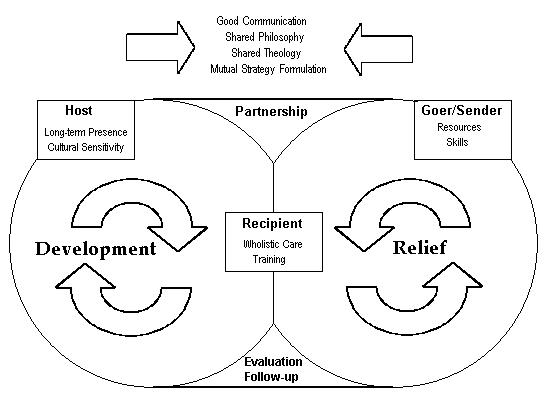
Double Vortex Model of Ministry
Thoughts on “Wholism”
“Wholism” is a term used by some in Christian ministry to describe the focus on the whole person or the whole community. Some people spell it “Holism”. However, even though “wholism” and “holism” theoretically are the same word, people often use them differently. The usage of “wholism” comes closer to how we wish to use it.
Wholism places itself in opposition to “Dualism”. Dualism tends to see the world in terms of opposing concepts with no real middle. In ministry, dualism shows itself in spiritual ministries versus social ministries. Spiritual ministries might be thought of as evangelism, preaching, discipleship and such. Social ministry might be viewed as feeding, job training, providing shelter and so forth. Wholistic ministry seeks to do both and fill in the gaps between.
Here are a couple of models for wholism:
Wholistic Growth:
This is sometimes looked at as the Luke 2:52 Model. In that verse Jesus was described as growing in wisdom and stature, and in favor with God and man. This verse suggests four types of simultaneous growth: MENTAL, PHYSICAL, SPIRITUAL, SOCIAL. Wholistic growth suggests that ministry should seek to cover these four areas.
Wholistic Health:
This comes from the CHE model (Community Health Evangelism/Education) from Lifewind. It is also related to the World Health Organization view on health accept that it includes the spiritual component. Good health is seen in terms of good relationships. The four relationships it covers is: Good relationships with ONESELF, OTHERS, GOD, and the ENVIRONMENT.
Both models are pretty similar even if different ministries might end up in different categories. One model focuses on growth/development. The other focuses on health/relationships. This is a case of not choosing one or the other, but recognizing that both are important. We are created by God to live in harmony (good relationships), but also to continue to grow and develop.
 Bukal Life Care