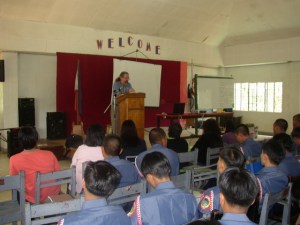
Mini-Medical Work at CARTS

P1010008

Celia and Angie doing pre-check-up evaluations

P1010009
Busy at the Pharmacy

November 10, we did Phase III of our CARTS police cadet ministry. The police cadets were involved in landslide work and body recovery in response to Typhoon Pepeng.

Phase I.  Provided supplies and vitamins to help cadets in their landslide work.

Phase II.  Provided crisis intervention with cadets, and crisis care training.

Phase III. Held mini-medical with cadets. Many suffer from coughs as a result of the long hours of work at the landslides and breathing in the dirt and dust there.  We were able to treat 173 cadets… giving medicines and vitamins for them.

Once again we thank Col. Paredo and Major Benitez, particularly, for their concern for the physical and spiritual well-being of the students under their care at the Police National Training Center at CARTS.

We also thank Dr. Colomma and the numerous nurses and other volunteers who helped make all of this come together.

Thoughts on “Wholism”

“Wholism” is a term used by some in Christian ministry to describe the focus on the whole person or the whole community. Some people spell it “Holism”. However, even though “wholism” and “holism” theoretically are the same word, people often use them differently. The usage of “wholism” comes closer to how we wish to use it.

Wholism places itself in opposition to “Dualism”. Dualism tends to see the world in terms of opposing concepts with no real middle. In ministry, dualism shows itself in spiritual ministries versus social ministries. Spiritual ministries might be thought of as evangelism, preaching, discipleship and such. Social ministry might be viewed as feeding, job training, providing shelter and so forth. Wholistic ministry seeks to do both and fill in the gaps between.

Here are a couple of models for wholism:

Wholistic Growth:
This is sometimes looked at as the Luke 2:52 Model. In that verse Jesus was described as growing in wisdom and stature, and in favor with God and man. This verse suggests four types of simultaneous growth: MENTAL, PHYSICAL, SPIRITUAL, SOCIAL. Wholistic growth suggests that ministry should seek to cover these four areas.

Wholistic Health:
This comes from the CHE model (Community Health Evangelism/Education) from Lifewind. It is also related to the World Health Organization view on health accept that it includes the spiritual component. Good health is seen in terms of good relationships. The four relationships it covers is: Good relationships with ONESELF, OTHERS, GOD, and the ENVIRONMENT.

Both models are pretty similar even if different ministries might end up in different categories. One model focuses on growth/development. The other focuses on health/relationships. This is a case of not choosing one or the other, but recognizing that both are important. We are created by God to live in harmony (good relationships), but also to continue to grow and develop.

Coroz, Tublay Project Report

Trip Report: Coroz, Tublay, Benguet
Date: October 31, 2009
Purpose: Post-Typhoon Pepeng Community Support

Host: The Winter Family, Missionaries in the Tublay region

Partners: Virginia Baptist Mission Board (Financial and Training)
Members of several churches including (but not limited to):
-Union International Church, Baguio
-Greenhills Christian Fellowship, Baguio
-Calvary Baptist Church, Baguio
-Beacons of Christ, Baguio
-Various AG congregations, Tublay

Services Provided:

Medical Care/Pharmacy/Crisis Care Counseling: 85
Dental Care/Crisis Care Counseling: 40
Children Ministry: Balloons, Songs, Coloring, etc. 70
School Teachers Trained in Crisis Care Counseling 5
Disaster relief Several sacks full of clothes.
Total people ministered to: about 180

Coroz is a small mountain community in the district of Tublay. During Typhoon Pepeng (also known as Parma), the area was devastated by landslides. At the request of the Winters, we visited the site and determined that it would be a good location for a medical mission. We decided to focus on crisis counseling. Often we do classic Christian evangelism, but decided that it was inappropriate under these circumstances. The recovery time after a traumatic experience is generally a bad time to make life decisions.

The road to Coroz was difficult. In many places on the Halsema Highway, the road had been cut away by landslide resulting in dangerous looking detours. The 1 lane road from the Highway to Coroz looked rough and slippery and was also damaged by storm. Nevertheless, we arrived at the mission site, the elementary school in Coroz, to find very few adults but lots of children. As the adults came in they were brought over to do crisis care counseling. This appeared to be very effective, with many able express their emotions about the disaster. The children we taken elsewhere where they sang songs, and did coloring. One of the things they were asked to do was to draw what they experienced during the typhoon. The drawings showed the depth of the fear and pain related to this event. When the principal of the school saw these pictures she saw the need for her teachers to be able to address the situation. Therefore, we provided training for the teachers in how to help the children in Coroz work through the emotions of the event and fears regarding recurrence.

While we were there, a truck arrived with school supplies. These were provided by UNESCO. That was a big help to the children… many of whom had considerable losses in this area.

Follow-up:

On of the major losses expressed by the children was of tsinellas (sandals/flip-flops). They are often placed just outside of the doors of houses. So many of them were washed away by the storm. Therefore, we bought a large supply of tsinellas. These will be delivered to the elementary school at Coroz.

Thanks:

We thank the Winter family, Shane, and others from the Tublay area for making arrangements for our mission. We thank Chaplain Charlie Benton, of the Virginia Baptist Mission Board, for coming from the US to help in training us in Crisis Care Counseling. We thank Ptr. Manny Domeris, of Calvary Baptist, for working with friends and local leaders in arranging transportation over the rough roads. We also thank Principal Brigette of Coroz Elementary School for hosting us in Coroz and being concerned for the teachers and children there. To all members of the team, we give thanks to God who brings together His people from all over the world to do great things in His service.

P1010047

Children Singing during Disaster Relief Mission

CARTS Project Report

CARTS Police Cadets Project.

inspection oct. 21, 2009 001

Police Cadets Doing Landslide Recovery Work

aP1010001 (6)

Chaplain Benton leading training at CARTS

One of the hidden victims of disaster is recovery workers afterwards. We had the wonderful opportunity to develop a relationship with many of these people. One such group is the CARTS (Cordillera Administrative Region Training School) for police cadets. They had to set aside from their normal studies to work over 12 hours a day digging out landslides and search for victims. This is a very difficult job and one that, sadly, often does not get appreciated. We were able to work with a number of doctors, businessmen, and churches in providing vitamins, facemasks, gloves, and other needed items for their work. After their digging work was done, they needed to return to classes, but the memory lives on. For many, this was their first face-to-face encounter with the recovery of the dead. We were invited to speak to them on November 2nd. The day was divided up into 4 major sessions, each about 90 minutes. The first session was crisis intervention, where cadets were given the opportunity to share their experiences and discover meaning in this situation. The 2nd through 4th sessions were to help cadets and instructors in providing emergent crisis care. Since many of these cadets will become law enforcement officers who regularly meet people undergoing crises, this training should be a great help. We provided some Crisis Care manuals from the Virginia Baptist Mission Board Disaster Relief Program, and most of the discussion was led by Chaplain Benton of the same group. We provided merienda in the morning and afternoon, while CARTS provided a wonderful lunch for our team. Follow-up medical screening is planned for November 10th since a large number of cadets are suffering from coughs and other similar symptoms after the disaster relief work. Thanks to Colonel Paredo Jr., and Major Benitez in inviting us to be partnered with their work at CARTS. Approximately 221 cadets were helped and trained, along with several staff.

Thanks Charlie!!

Crisis Care Chaplain

Crisis Care Chaplain, Charlie Benton

Chaplain Charlie Benton, of Virginia Baptist Disaster Relief,  was able to join us in Baguio to work in providing crisis care intervention for those who suffered with the ravages of Typhoon Pepeng, which left hundreds dead, and thousands with destroyed or damaged homes. He also did training with our team and other groups so that we can provide effective crisis care in the future.   The following is an abridged list of the activities that we did together.

The following shows list of activities:

1.  October 31             Medical Disaster Mission, Coroz, Tublay

-180 total people served

-85 received medical care  and crisis counseling

-40 received dental care and crisis counseling

-70 children did songs, games, and craft time.

-5 teachers received training in crisis care intervention

2.  November 2          At CARTS (Cordillera Administrative Region Training School) for police cadets.

-90 minute intervention for 221 cadets

-4.5 hours of crisis counseling training for 241 individuals

3.  November 3 and 5         Student Training, Philippine Baptist Theological

Seminary (Part 1)

-30 students

-3 hours training in Crisis Care

4.  November 4            Teacher Training, Union School International (Empathic listening)

-16 students

-60 minutes

5.  November 5            International Red Cross, Baguio Chapter training

-14 students

-2 hours in Crisis Care Training

This was a wonderful time to learn, fellowship, and help people (who, sadly, have suffered so much during this time).

What’s Up November 2009

Here are a few things that are happening in the next 4 weeks.

-November 10.  Medical Screening for police cadets at CARTS (Cordillera Administrative Region Training School).

-November 14.  Crisis Care Counseling and Medical/Dental Mission. In Belong, Tublay (Benguet Province).

-November 27.  Medical/Disaster Relief Mission. Bagulin, La Union