We have a number of big things coming up at Bukal. Primary among these is Clinical Pastoral Education:
-CPE Summer Intensive (May 26 – August 15). Full Unit
-CPE Summer Intensive (June 11 – July 18). Half Unit (CPO)
We still have some openings available for our Full Unit batch. Our Half Unit is possibly full. However, if there is enough interest, we can perhaps start another group in the batch.
Please contact us soon at bukallife@gmail.com if you have questions. (Or address questions in our Contact Us Page.
2. There are a few projects coming up as well. Here are a few:
-April 23-25. Training Project with The Salvation Army (Laguna)
-June 7-8. CPSP-Philippine Plenary Gathering in Santa Maria.
-August 13-16. OSB 6th Triennial Missions Congress
3. We have a number of copies of “The Art of Pastoral Care” by Robert and Celia Munson at our office in Baguio City. They are P350 each. Email us if you want a copy. (Additional cost if it needs to be shipped.) Note that for those in other countries or those who want an electronic copy can do so by ordering it online (Amazon and other vendors.
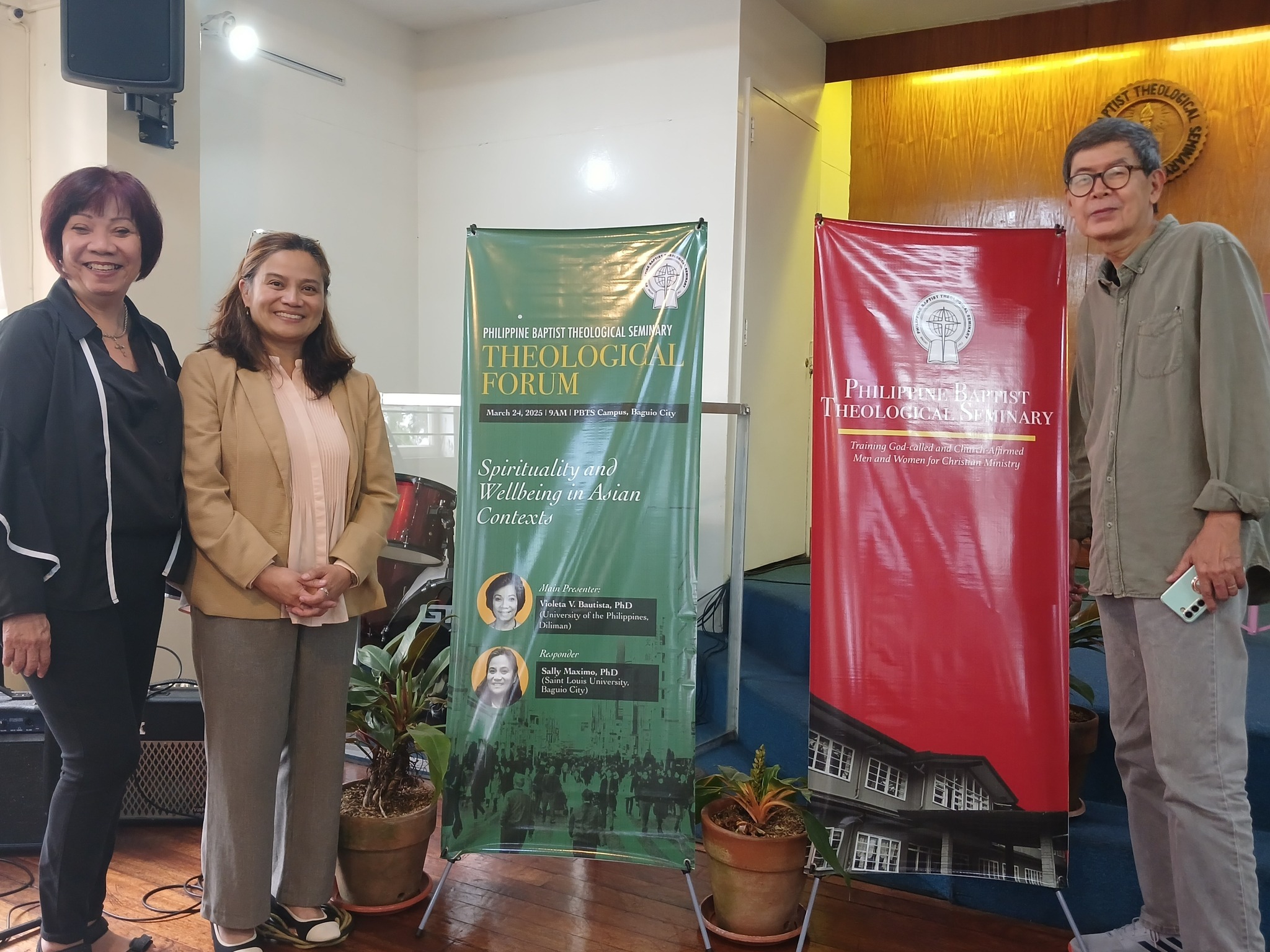
Philippine Baptist Theological Seminary held a seminar on Monday, March 24. The topic was “Spirituality and Wellbeing in Asian Contexts.” Dr. Violeta Bautista, Director of Psychosocial Services at UP-Dilliman, did gave the primary presentation with Dr. Sally Maximo, professor of psychology at Saint Louis University provided the response. Dr. Boy Bautista joined in two in the panel discussion. Approximately 80 attended.
Drs. Bolet, Bing, and Boy (Bautista, Maximo, and Bautista)
The Commissioning Service for our CPE trainees will be on March 15th at 10am at Philippine Baptist Theological Seminary (in Chapel A). The commissioning is welcome to all, but the lunch after is only for trainees, staff, and specially invited guests.
Also check in earlier posts about the CPSP-Philippines Plenary in June, and the Theological Symposium on Spirituality and Wellness at PBTS at the end of March.
St. Gregory of Nazianzus (circa 329AD-390AD) was one of the Cappadocian Fathers and had a great influence on the early (post-Nicene) church.
He also had a great impact on Pastoral Care, especially in what is known as his Second Oration. Here he notes the similarities between pastoral care and medical care, noting that it requires great wisdom because each case is unique. Below is an excerpt from that document. However, if you want to read a translation of the entire document, you can go and CLICK HERE.
It is worth nothing that Pope Gregory the Great’s “Pastoral Care,” although written centuries later, draws heavily from this document.
30. As then the same medicine and the same food are not in every case administered to men’s bodies, but a difference is made according to their degree of health or infirmity; so also are souls treated with varying instruction and guidance. To this treatment witness is borne by those who have had experience of it. Some are led by doctrine, others trained by example; some need the spur, others the curb; some are sluggish and hard to rouse to the good, and must be stirred up by being smitten with the word; others are immoderately fervent in spirit, with impulses difficult to restrain, like thoroughbred colts, who run wide of the turning post, and to improve them the word must have a restraining and checking influence.
31. Some are benefited by praise, others by blame, both being applied in season; while if out of season, or unreasonable, they are injurious; some are set right by encouragement, others by rebuke; some, when taken to task in public, others, when privately corrected. For some are wont to despise private admonitions, but are recalled to their senses by the condemnation of a number of people, while others, who would grow reckless under reproof openly given, accept rebuke because it is in secret, and yield obedience in return for sympathy.
32. Upon some it is needful to keep a close watch, even in the minutest details, because if they think they are unperceived (as they would contrive to be), they are puffed up with the idea of their own wisdom. Of others it is better to take no notice, but seeing not to see, and hearing not to hear them, according to the proverb, that we may not drive them to despair, under the depressing influence of repeated reproofs, and at last to utter recklessness, when they have lost the sense of self-respect, the source of persuasiveness. In some cases we must even be angry, without feeling angry, or treat them with a disdain we do not feel, or manifest despair, though we do not really despair of them, according to the needs of their nature. Others again we must treat with condescension and lowliness, aiding them readily to conceive a hope of better things. Some it is often more advantageous to conquer — by others to be overcome, and to praise or deprecate, in one case wealth and power, in another poverty and failure.
33. For our treatment does not correspond with virtue and vice, one of which is most excellent and beneficial at all times and in all cases, and the other most evil and harmful; and, instead of one and the same of our medicines invariably proving either most wholesome or most dangerous in the same cases — be it severity or gentleness, or any of the others which we have enumerated — in some cases it proves good and useful, in others again it has the contrary effect, according, I suppose, as time and circumstance and the disposition of the patient admit. Now to set before you the distinction between all these things, and give you a perfectly exact view of them, so that you may in brief comprehend the medical art, is quite impossible, even for one in the highest degree qualified by care and skill: but actual experience and practice are requisite to form a medical system and a medical man.
34. This, however, I take to be generally admitted — that just as it is not safe for those who walk on a lofty tight rope to lean to either side, for even though the inclination seems slight, it has no slight consequences, but their safety depends upon their perfect balance: so in the case of one of us, if he leans to either side, whether from vice or ignorance, no slight danger of a fall into sin is incurred, both for himself and those who are led by him. But we must really walk in the King’s highway, and take care not to turn aside from it either to the right hand or to the left, as the Proverbs say. For such is the case with our passions , and such in this matter is the task of the good shepherd, if he is to know properly the souls of his flock, and to guide them according to the methods of a pastoral care which is right and just, and worthy of our true Shepherd.
At Bukal Life Care we are starting our first cycle of CPE the middle of this January— in Baguio City and Palawan. Our plan at this time is to have:
First Cycle: Full Unit (Intensive and Extended) Starting January
Second Cycle: Full Unit (Intensive) Starting May or June
Third Cycle: Half Unit (Intensive) Starting in June or July
Fourth Cycle: Full Unit (Intensive and Extended) Starting September
We have updated our CPE Handbook. We also have, in line with our CPE Training Center partners, increased our overall charge for training starting January 2025. Full unit is now P22,000, while Half unit is now P13,000.
In addition, we are planning to have pastoral training seminars. Some have already been identified as possible or likely in Quirino Province, Nueva Viscaya, and Mindanao.
If you have any questions or concerns, please email us at bukallife@gmail.com, or send us a message through the Contact Us page on this website.
Starting in January 2025 the cost for Clinical Pastoral Education will increase.
Cost for Full Unit (Intensive and Extended): P22,000
Cost for Half Unit (Intensive and Extended): P13,000
For Full unit, this constitutes a 10% increase. For both Full and Half unit, 80% of the cost is for Supervision (both SIT and Diplomate supervision), and 20% is for Admin costs and Accreditation.
Originally the reason for the increase was to put us more in line with other CPE programs in the Philippines, especially with our accreditation organization, CPSP-Philippines. However, there have been some unexpected increases to our admin costs in 2024 making the increase necessary.








 Bukal Life Care