
A fascinating study done by David Rosenhan of Stanford University illustrates the impact of psychiatric labeling. Rosenhan and several colleagues had themselves committed to mental hospitals with a diagnosis of “schizophrenia.” After being admitted, each of these pseudo-patients dropped all pretense of mental illness. Yet, even though they acted completely normal, none of the researchers was ever recognized by hospital staff as a phony patient. Real patients were not so easily fooled. It was not unusual for a patient to say to one of the researchers, “You’re not crazy, you’re checking up on the hospital!” or “You’re a journalist.”
To record his observations, Rosenham took notes by carefully jotting things on a small piece of paper hidden in his hand. However, he soon learned that stealth was totally unnecessary. Rosenhan simply walked around with a clipboard, recording observations and collecting data. No one questioned this behavior. Rosenhan’s note taking was just regarded as a symptom of his “illness.” This observation clarifies why staff members failed to detect the fake patients. Because they were in a mental ward, and because they had been labeled schizophrenic, anything the pseudo-patients did was seen as a symptom of psychopathology.
As Rosenham’s study shows, it is far better to label problems than to label people. Think of the difference in impact between saying “You are experiencing a serious psychological disorder” and saying, “You are a schizophrenic.”
-Dennis Coon, “Introduction to Psychology: Gateways to Mind and Behavior,” 9th edition. pages 556-557
Category Archives: Commentary
Leadership, Power and Authority in the Church and Home
Leadership, Power and Authority in the Church and Home.
Important video on power, control, leadership, and abuse in the church (particularly) and elsewhere.
Our Latest E-Journal
<div style=”margin-bottom:5px”> <strong> <a href=”https://www.slideshare.net/bmunson3/bukal-life-care-journal-2013″ title=”Bukal Life Care Journal 2013″ target=”_blank”>Bukal Life Care Journal 2013</a> </strong> from <strong><a href=”http://www.slideshare.net/bmunson3″ target=”_blank”>Bob Munson</a></strong> </div>
Theology and Psychology: Brief Consideration
We get questions at times with regards to the relationship between the Christian faith and Psychology when it comes to counseling. Between various schools of thought, some of whom appear to be at war with each other, it can be quite difficult to know what is what, to say nothing about what is right. We are not going to try to explain all of the differences. A good place to start would be “Psychology & Christianity: Five Views” edited by Eric L. Johnson, with contributors from five schools David G. Myers, Stanton L. Jones, Robert C. Roberts, P. J. Watson, John H. Coe, Todd W. Hall, David A. Powlison. The five “schools” are:
–Levels of Explanation
-Integrationist
-Transformational Psychology
-Christian Psychology/Counseling
-Biblical Counseling
Transformational Psychology on first glance at least seems to simply be a type of Christian Psychology. Because of lack of detailed knowledge of Transformational Psychology, and because our counseling center tends to work mostly within the Pastoral Care movement, the diagram shows Pastoral Care instead.
If the X-axis shows the focus of the counseling. The farther to the right, the greater the emphasis on theology. The farther to the left, the greater the emphasis on (secular) psychology. Near the origin on the X-axis is a more balanced approach. The Y-axis shows the philosophy of the counseling. The farther positive (“up”) the greater the philosophy towards integration of theology and psychology. The farther negative (“down”) the greater the philosophy of separation, or reducing dialogue between theology and psychology in treatment.
It is important to note that the X-axis has on the positive side “theology” not “Bible.” There is a couple of reasons for this. For one, while Bilbical Counseling describes its basis as the Bible, not everyone would agree that its principles are Biblical. Rather, it is safer to say that that Biblical Counseling is based on a theological understanding of the role of the Bible in counseling. A second reason for using the term “theological” is that the Pastoral Care movement takes very seriously the integration of faith/theology and psychology, but some practitioners utilize theologies that do not have the Bible as its base.
Looking at the four quadrants, the five views covered produce a continuous (and overlapping) curve. At one extreme in the lower left is the “Levels of Explanation” view. It tends to focus on Psychology and separates human problems into categories (levels of explanation)… some that are the domain of psychology, and some that are the domains of other specialties. In the upper left are the Integrationists. While all in the upper quadrants could be described as integrational, here the term tends to be used by those that focus more on psychology than on theology. Those that are more integrationist (strong) see a greater role for theology. Those that are less integrationist (weak) see a lesser role for theology.
In the upper right quadrant are two groups. One is Christian Counseling and the other is Pastoral Care. Arguably, these two greatly overlap. Both place a strong role for theology but seek to be effectively informed by findings in secular psychology that have been found useful. Since both Christian Counseling and Pastoral Care overlap, they could easily be seen as one school. They are often kept separate for two reasons. First, they developed differently. Christian Counseling came as a reaction to integrationists on one side and Biblical counseling on the other, in the 1980s. Its underlying theology tends to be relatively conservative. Pastoral Care is older coming from the Clinical Pastoral Training movement in the 1920s and beyond. While it does not, strictly speaking, have only one underlying theological perspective, the average pastoral care practitioner would be seen as more theologically liberal than the average Christian counselor. In the lower right quadrant is Biblical Counseling. It was a reaction to the left quadrant practitioners in the early 1970s. Originally known as Nouthetic Counseling. It takes a more negative view of psychological principles and methods that are seen as not coming from the Bible. As such there is a strong separation between counseling they feel is consistent with the Bible, and counseling based on sources outside the Bible. Recent movements in Biblical Counseling have sought to find more integration, but separation still dominates the movement.
Perhaps it is best not to focus on “Who is right” and focus on what each has to offer. Biblical Counseling tends to focus on sin and behavioral changes. In some cases that is the care needed. For serious psychoemotional problems such as personality disorders and psychoses, the integrationists and levels of explanation practitioners are better prepared to assist recovery. For problems such as conflicts, being “sinned against,” self-esteem, and such, perhaps Christian counseling and Pastoral Care have more tools to help.
When it comes to treatment, one size may NOT fit all.
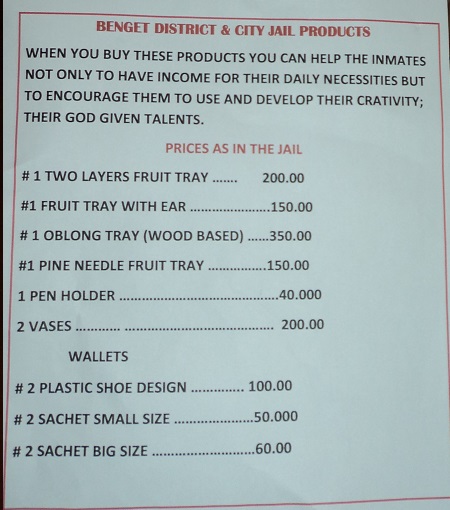
Products from Jail in Baguio and Benguet
Some of our Chaplain Trainees have been working with the Baguio City Jail and Benguet District Jail (La Trinidad). They asked if we could put some of the products produced by the inmates (as part of their retraining and income development) would be put on the Web. The items that are brown look like they are wicker, but are actually skillfully made from tightly rolled-up newspaper. You would be amazed at some of the products and how they are made from things most of us throw away. We own a beautiful swan sculpture picture frame made at the Baguio City Jail from gum wrappers. It is inspiring and reminds us how God takes people the world has “thrown out” and makes something wonderful and new from their lives.
We are not a store (and don’t plan to become one anytime soon). Still, we are wholeheartedly in support of helping the inmates in their wholistic growth and rehab. If you have any questions about the products, please forward them to us at info@bukallife.org, and we will gladly forward them to Sister Tammy.

But What do you MEAN??
Books are not meant to be believed, but to be subjected to inquiry. When we consider a book, we mustn’t ask ourselves what it says but what it means. -Umberto Eco
The quote above can lead some to say, “That’s foolish! It says what it means, and means what it says!”
A clue to the challenge of the quote is that meaning is more tied to value than to facts. People commonly give facts to support certain values. But facts alone don’t reveal these values commonly. That’s because value is part of the affective part of our being, rather than cognitive or behavioral Also, part of the affective part of ourselves is our emotions. In fact, it is hard to draw clear boundaries between emotions and values— they are intertwined.
If, then, one wants to know what something means to another, listen to emotion or feeling words. Take the following example.
John says, “My uncle died yesterday.”
Now you know the facts, but what does that really MEAN to John? You can only guess. Rather than guessing, you could ask, “Oh my… you does that make you feel?”
John could give many different responses.
- “I’m so very sad. He was like a second father to me.”
- “Happy! He hurt everyone he knew. I’m glad he’s gone.”
- “I feel lost. He was paying for my schooling. What do I do now?”
- “Angry! He was supposed to take care of my auntie. Instead, he drank himself to death.”
- “I don’t know. I don’t feel much of anything. I barely knew him.”
When we talk to people… we need to focus less on facts than meaning.
A Healthy Faith?
In Pastoral Care and Pastoral Counseling, it is generally believed that the faith of the individual can be a vital part of the healing process. This belief is built from a more fundamental assumption that faith is healthy. Yet, what is faith?
One of the best works I have seen on faith was written close to 40 years ago. Wayne E. Oates, a Christian Psychologist (and writer and seminary professor) wrote a book in 1973 called The Psychology of Religion. The final chapter (19) is titled “Toward a Psychology of Faith.” As a Christian, Oates valued faith. However, as a Christian Psychologist, he understood that some understandings of “faith” (both inside and outside of faith communities) may be psychologically destructive. So Oates sought to find a good understanding of the Biblical view of faith, informed by psychology, while avoiding unhealthy faith (or unhealthy things that are called faith by some).
- Unhealthy Faith involves allegiance to the irrational
- Unhealthy Faith involves trust without demonstrated trustworthiness
- Unhealthy Faith is absence of, or denial of, doubt
The following is an excerpt from the chapter, under the subheading of “Faith as an Act of Surrender.” The chapter looks at faith in terms of faith in God, but also faith in other relationships. Thus it doesn’t look simply at “saving faith” but healthy faith in its many forms.
… faith involves a surrender of one’s childish sense of omnipotence, that is, an acute sense of total responsibility for everything other people do. One sees it in clinicians of every kind— doctors, ministers, social workers, psychologists, and so on— who feel themselves a failure unless they can be everything and totally succeed with persons in their care. One sees it in parents who accept total responsibility for the thoughts, values, and acts of their children. Faith as an act of surrender in such situations can be expressed in the account of a World War II solder who volunteered for combat without his father’s explicit approval. Upon sailing for Europe, his father said to him, “Son, your mother and I have done all for you we can. You’re on your own now. You have made your bed and you will just have to lie in it.” Then nearly thirty years later he says, “I thought he was angry, then. But being a father now, I can see he was telling me that he cared but that there were limits beyond which he could not go in doing so.” He exercised an act of surrender, or a life of faith, in order to survive the pain, the anxiety, and the helplessness of seeing his son in war.
Yet surrender is not a once-for-all giving up of one’s need to be totally responsible and all-powerful. It is a daily, twenty-four-hour-at-a-time exercise of faith. It must be done again and again, not as a work of merit but as a means of spiritual survival as a finite self in one’s own right before God. Without this faith, all sorts of substitutes— drugs, alcohol, work— become the insulation of terror, the inducers of sleep.
When is it NOT okay to say “God is Good”?

People of faith often know the right thing but still end up saying the wrong thing. Commonly, bumper sticker phrases like “It must be God’s will,” “Everything will work out,” and “I’m sure it’s for the best” pepper our conversations with people struggling. I would like to think that we know better than to say this, but somehow fall into meaningless aphorisms when we under pressure to give a word of wisdom.
A good example of this is the bumper sticker phrase “God is Good, All the Time.” Rather than get into the question of whether God IS indeed always good (from our perspective), let’s consider if there are times when the phrase is not useful in conversation. Try the following Blog Post for this question:
The preacher shouted out, “GOD IS GOOD!” And the congregation responded, “ALL THE TIME!” At which point the choir picked up it’s cue:
God is good all the time
He put a song of praise in this heart of mine
God is good all the time
Through the darkest night, His light will shine
God is good, God is good all the time
But Christians have developed the bad habit of saying “God is good” in a way that suggests that sometimes God is not good. This is because, whether we like it or not, some elements of the prosperity gospel has seeped into the wider Christian subculture.
The rest of the article is HERE
 Bukal Life Care